HireVue alternatives for 2026: a category map for TA leaders
"HireVue alternatives" is the most-searched buyer query in AI hiring software. Here are the five real categories of answer in 2026, and how to pick the right one for your team.
Why "HireVue alternatives" is searched so much in 2026
If you've landed on this page, you're probably one of three people:
A TA leader whose contract is up and you're not sure you want to renew.
A new VP of Talent who inherited a HireVue contract and is rebuilding the screening stack.
A recruiter whose candidates keep complaining about the one-way video format.
All three lead to the same question: what else is out there in 2026, and which category should we even be looking at?
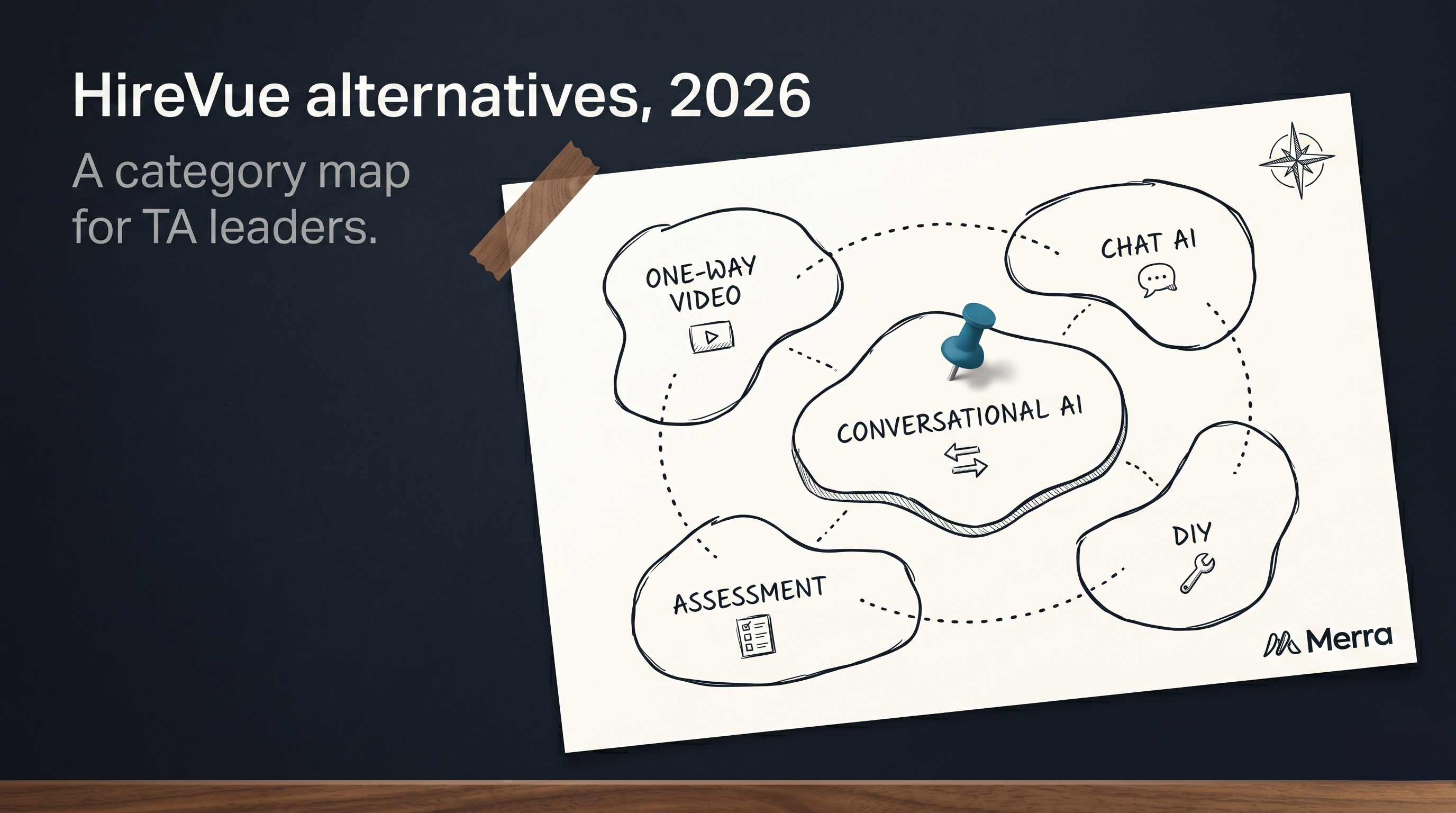
The space has fragmented. HireVue itself has spent the last few years adding game-based assessments, AI scoring, and (after public criticism, publicly announced in January 2021) dropping facial analysis from its scoring models. Meanwhile, a new generation of conversational AI interviewing platforms has emerged that doesn't use the one-way video format at all. The "alternatives" question now has at least five different answers, depending on what you're actually trying to fix.
This post is the map. Categories first, then evaluation framework, then the questions to ask.
What HireVue is, exactly
So we're comparing apples to apples. HireVue is an enterprise hiring platform (founded 2004, South Jordan, Utah) built originally around the one-way pre-recorded video interview, a format it helped invent alongside Montage in the early 2010s. The candidate gets a list of questions, records video answers on their own time, and the recordings sit in the platform for recruiters to watch and rate. The platform has expanded over the years into AI-powered scoring, game-based assessments, virtual job tryouts, and ATS integrations. It's primarily sold to large enterprises at enterprise pricing.
The thing being criticised in 2026, when people search "HireVue alternatives," is usually not the company itself. It's the format. One-way video interviews are:
A monologue, not a conversation. No follow-up questions, no clarification, no probe when an answer is too smooth.
A performance, not a signal. Candidates rehearse, re-record, and submit polished takes.
A poor candidate experience. Anyone who's done one will tell you.
Hard to score consistently. Recruiters end up watching on 2× speed and skimming.
The alternatives below address this in five different ways.
The five categories of HireVue alternatives in 2026
Category 1: Other one-way video platforms
Examples: Willo, Spark Hire, VidCruiter, myInterview.
Same format, different vendor. These are typically positioned at SMB and mid-market teams: simpler setup, more flexible contracts than enterprise HireVue. If your problem with HireVue is the price tag or the implementation overhead, these are a real option. If your problem is the format itself, switching to another one-way video tool will not fix it.
Best for: teams who like the one-way video format and want lower cost or simpler setup.
Category 2: Chat-based AI interviewing
Examples: Sapia.ai, Paradox (Olivia), and HireVue's own chat product.
The candidate has a text-based chat with an AI interviewer. No video. Lower friction, more accessible (works on any phone, no bandwidth issue), and faster to complete. Particularly strong for high-volume frontline and hourly hiring where the format doesn't need to be conversational.
Trade-off: chat surfaces less of how a candidate actually communicates verbally. For roles where presence, articulation, or conversational thinking matter (sales, customer-facing, leadership), chat is a downgrade compared to a real conversation. You're optimising the wrong signal.
Best for: very-high-volume hourly, frontline, retail, and contact-centre hiring.
Category 3: Conversational AI interviewing
Examples: Merra (us), Alex (formerly Apriora), and Ribbon.
The candidate has a real-time, voice or video conversation with an AI interviewer. Same questions every time, follow-up probes when an answer is too smooth, recording, transcript, and scored evaluation per candidate. The closest format to a human first-round phone screen, run at the volume of your real funnel.
Trade-off: newer category, fewer enterprise reference customers than HireVue. Real-time conversational AI is also more expensive per interview to run than chat, because the underlying voice and model stack is heavier.
Best for: teams whose first-round screening problem is a format problem (one-way video isn't producing useful signal) and who want recording, transcript, and scored evaluation per candidate, not just on the shortlist.
<aside> 🚩
Honest disclosure. This is the category Merra is in. The rest of this post is careful to flag the difference between category-level claims (which are general and apply to every conversational AI vendor) and Merra-specific claims (which I'll mark explicitly).
</aside>
Category 4: Assessment-led platforms
Examples: Pymetrics (now part of Harver), Plum, eSkill, Codility and HackerRank for technical roles.
These don't replace the interview. They replace or augment the CV-screen step with a skills, behavioural, or game-based assessment. Strong predictive power for some categories of role (Codility for software engineering, structured behavioural assessments for high-volume frontline). Weaker for senior or judgement-heavy roles where the work is hard to assess in a 30-minute task.
Trade-off: assessment fatigue. Asking every applicant to spend 45 minutes on a game or test before they get a real conversation will hurt your conversion at the top of the funnel.
Best for: technical hiring (Codility, HackerRank), or specific high-volume frontline roles where the assessment is a strong proxy for the job.
Category 5: DIY (build your own)
There are two honest shapes of DIY in 2026, and they're very different in cost and complexity.
Option A: async, low-volume, achievable today. A human runs the first-round interview on Zoom or Google Meet. The session is recorded and transcribed using the platform's native transcript or a tool like Otter or Fireflies. The transcript is then scored against a custom rubric by handing it to Claude or GPT with a structured prompt. This adds AI-assisted scoring to a human-run conversation. It doesn't replace recruiter time, doesn't scale past a few dozen interviews a week, and pushes interview data into a third-party model (factor that into your compliance review). For early-stage teams running under 50 interviews a month, this is a real and defensible option.
Option B: real-time conversational AI, much harder. A custom build of an AI interviewer that actually talks to candidates in real time. Plugging "an LLM API" into Zoom is not what this requires. The actual stack is a real-time voice agent layer (speech-to-text, language model, text-to-speech, turn-taking and barge-in handling) running on a WebRTC or telephony backbone, plus scheduling, candidate intake, ATS integration, recording, transcript handling, audit trail, GDPR / SOC 2 / EEOC compliance, and prompt-version management. This is a 6–12 month engineering build for the voice infrastructure alone, before you ship to a single candidate. Almost no one outside a well-funded ML team should attempt it.
Best for: Option A for low-volume teams who want AI-assisted scoring on conversations they're already running. Option B for teams with a strategic reason to own the platform end-to-end and the engineering org to build it.
How to choose between the five
Three frames that cut through most of the noise.
Frame 1: What are you actually trying to fix?
Be specific about the problem before choosing a category.
Cost / contract bloat: Category 3 typically wins versus HireVue on price for like-for-like first-round screening, with per-role or per-interview pricing instead of a multi-year enterprise contract. Category 1 is cheaper still if you accept the bare-bones one-way video format and its signal trade-offs.
Candidate experience complaints: Categories 2, 3, or 4. The candidate-experience floor for one-way video is low; switching format will lift it.
Recruiter capacity / time-to-shortlist: Categories 2 or 3. Both can run on every applicant; both produce a ranked shortlist.
Quality of signal at first round: Category 3 is the highest-fidelity option for most roles. Category 4 wins for technical roles. Category 1 will not move this metric, regardless of vendor.
Compliance / audit trail: Categories 1, 3, and 4 all produce structured evidence. Category 2 produces transcripts but not voice. Category 5 produces whatever you build.
Frame 2: What's the role you're hiring for?
Different roles fit different formats.
Frontline / hourly / retail / contact-centre: Categories 2 (chat) or 4 (behavioural assessment) win on volume and candidate experience.
Sales / customer-facing / SDR / account management: Category 3 (conversational). The job involves real-time conversation, so the screen should test that.
Junior engineering / technical IC: Category 4 (technical assessment) for skills, plus Category 3 for behavioural and judgement.
Senior / leadership: Honestly, none of these. Senior hiring is too low-volume and idiosyncratic for any AI platform to add real value beyond bespoke human screens. Where AI helps is freeing up your team to do those bespoke screens well.
Frame 3: How big is your funnel?
The alternatives differ in where they break.
Under 200 applicants per role: Category 5 Option A (async DIY) and Category 3 (conversational) both work. Category 1 is overkill.
200–2,000 applicants per role: Categories 2, 3, and 4 all scale. Category 1 will work but loses most of the format advantage.
2,000+ applicants per role: Category 2 (chat) and Category 4 (assessment) have the throughput. Category 3 (conversational) works but per-interview cost matters more at this volume. Price the unit economics carefully.
The seven questions to ask any vendor before you switch
This is the same seven-question checklist from our buyer's guide for TA leaders, applied here specifically to comparing HireVue alternatives.
Format. Does the platform run a real conversation, a one-way recording, a chat, or an assessment? What is the candidate's actual experience?
Coverage. Does it run on every applicant, or only on a triaged subset?
Evidence. What does the platform produce per candidate? Recording, transcript, scored evaluation, decision summary? Available for how long after the interview?
Rubric configurability. Can you bring your own competency rubric, or are you using the vendor's defaults? Can you version it per role?
Validation. How does the platform validate its scoring against on-the-job performance, not just speed? Is there published methodology?
Bias auditing. Has the platform been audited for adverse impact? Per role, or generically? Is the audit available to you on request?
Switching cost. HireVue and most alternatives are tools that sit on top of your ATS, with candidates flowing ATS → tool → ATS, so switching is a tool swap rather than a data migration. Ask the vendor: how long does setup and onboarding take in days, what changes in the candidate flow, and who handles the ATS reintegration. Vendors who can't answer this clearly are hiding the answer.
If a vendor can't answer all seven without checking with their CTO, you're a year too early on them.
Where Merra fits, honestly
We're in Category 3. Conversational AI interviewing. Same questions, recording, transcript, scored evaluation per applicant. We're newer than HireVue. We have fewer enterprise reference customers. We don't ship game-based assessments. We don't ship a chat product. And we don't run on the one-way video format, because the format is the thing we think the category got wrong.
What we do well: every applicant gets a structured first-round conversation, the same rubric across every candidate for the same role, recording and transcript and scored evaluation per candidate, and a ranked shortlist with the evidence pack underneath each ranking, in your ATS, six months later when someone asks why a candidate was passed over.
What we don't replace: your senior leadership search process, your reference calls, your offer-stage decisions, your hiring-manager calibration. Those are still human, and they should be.
If your problem with HireVue is the format, we're a real alternative. If your problem is the price, Merra is typically less than half the cost of an enterprise HireVue contract for equivalent first-round screening (Merra-specific claim; Category 1 is cheaper still if you're willing to drop to bare-bones one-way video). If your problem is frontline volume, Category 2 is faster.
Run a pilot on one role and see the evidence pack Merra gives your team.
FAQ
Is HireVue still using facial analysis?
HireVue publicly announced it was dropping visual and facial analysis from its scoring models in January 2021, after public criticism and an independent algorithm audit (the internal change happened in early 2020 per HireVue and SHRM). The current platform scores primarily on the verbal content of the interview, not facial expressions or micro-gestures. If you're evaluating any AI hiring tool today, ask the vendor explicitly what their scoring model uses. The answer should be specific. "It uses AI" is not an answer.
What's the cheapest HireVue alternative?
For a like-for-like replacement of what HireVue actually does (structured first-round screening with recording, transcript, and scored evaluation per candidate), Category 3 (conversational AI) is typically the cheapest path. Merra specifically is typically less than half the cost of an enterprise HireVue contract for equivalent volume (Merra-specific pricing claim). Category 1 (other one-way video tools like Willo, Spark Hire, or VidCruiter) is cheaper still on a per-interview basis, but it isn't a like-for-like swap — you're keeping the one-way video format and the signal problems that come with it. Category 2 (chat-based) can get cheaper than Category 3 at very high volume because chat is computationally lighter than voice. Always price against your actual funnel volume, not the vendor's headline number.
Can I just use Zoom and ChatGPT to replace HireVue?
For low-volume async use, partly yes. You can run interviews yourself on Zoom or Google Meet, record and transcribe them, then run the transcript through Claude or GPT against a custom scoring rubric to add AI-assisted evaluation. That's Category 5 Option A, and it's real. What you can't do is plug an LLM API into Zoom and have an AI actually conduct the interview. Real-time conversational AI needs a voice agent stack (speech-to-text, language model, text-to-speech, turn-taking, telephony or WebRTC), plus scheduling, ATS integration, audit trail, and compliance. That's a 6–12 month engineering build before you ship to a single candidate, so for most teams it's not a serious DIY option.
How long does it take to migrate from HireVue?
"Migrate" is the wrong word for what's actually happening. HireVue is a tool that sits on top of your ATS — candidates flow ATS → HireVue → back to ATS with a recording and score attached. Replacing it with another vendor is a tool swap, not a data migration: there's no candidate-data port and no rubric history to preserve at the platform level. The actual work is ATS reintegration for the new tool, candidate-flow communication, and rubric setup. For Category 3 specifically, Merra deploys on top of your existing ATS in hours to under a day, including onboarding (Merra-specific claim). The longer pole for any vendor in this category is usually internal procurement and security sign-off, not the integration itself. Ask the new vendor for setup time in days, not weeks.
Should I run a head-to-head pilot?
Yes. The right shape is: pick one high-volume role, run HireVue on half the applicants and the alternative on the other half for 30 days, then compare hiring-manager confidence in the shortlist, candidate satisfaction (NPS or simple survey), and 90-day retention of any hires made through each track. Avoid pilots that compare the alternative against your current process with a CV-triage step in front. You'll be measuring two different funnels.
Ahmed Ghelle is the founder of Merra, an AI interviewing platform that runs structured first-round interviews on every applicant and produces a recording, transcript, and scored evaluation for each one. He writes about hiring, evidence, and the difference between speed and signal.
Ready to ace your next interview?
Practise realistic mock interviews with conversational AI and get actionable feedback. Start with a free interview.
Start your free interviewsKeep reading
 AI in Hiring
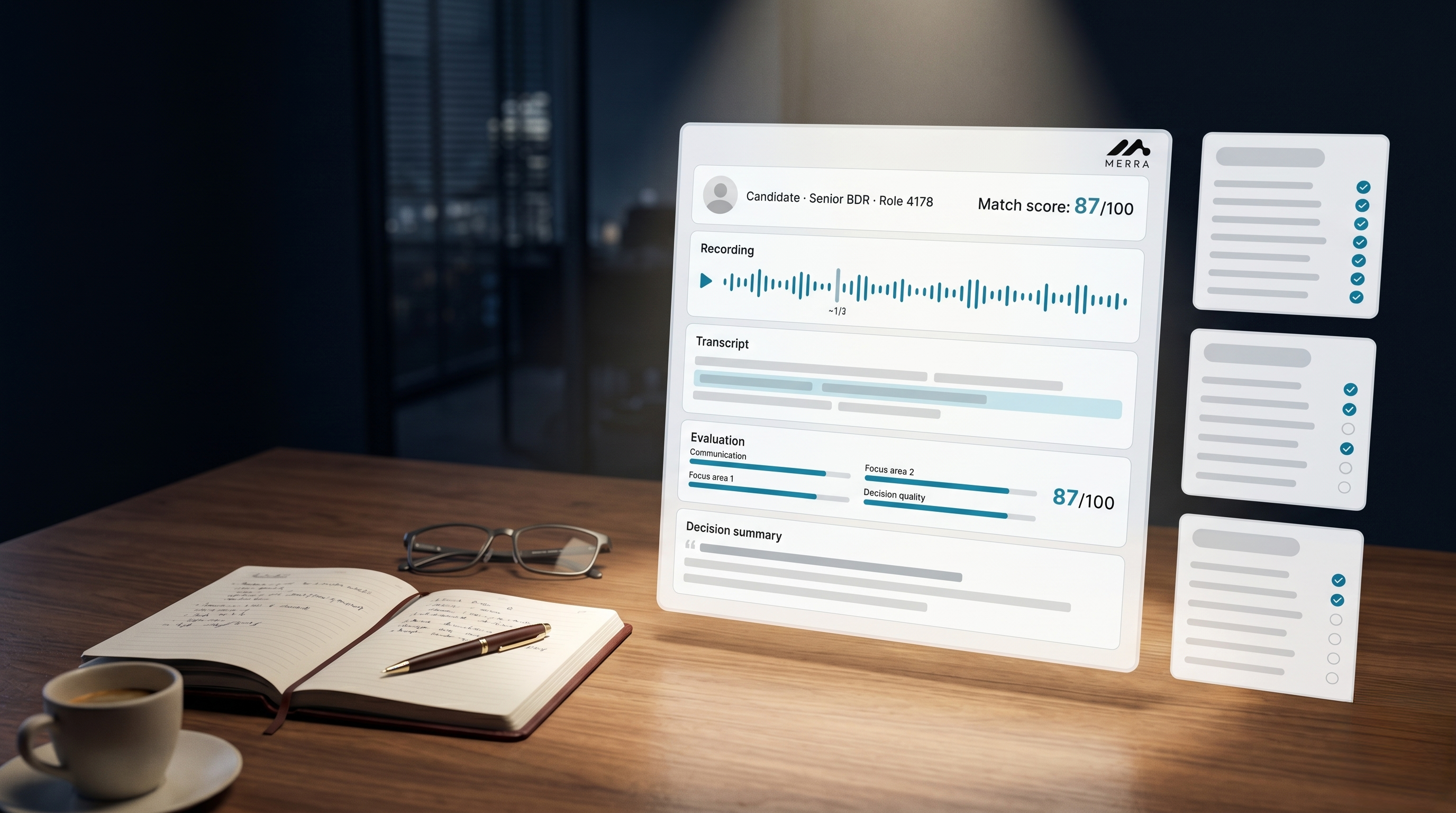
AI screening software: a buyer's guide for TA leaders
Most AI screening tools sell speed. The ones worth buying produce evidence. Here are the seven questions every TA leader should ask before signing a contract.
 AI in Hiring
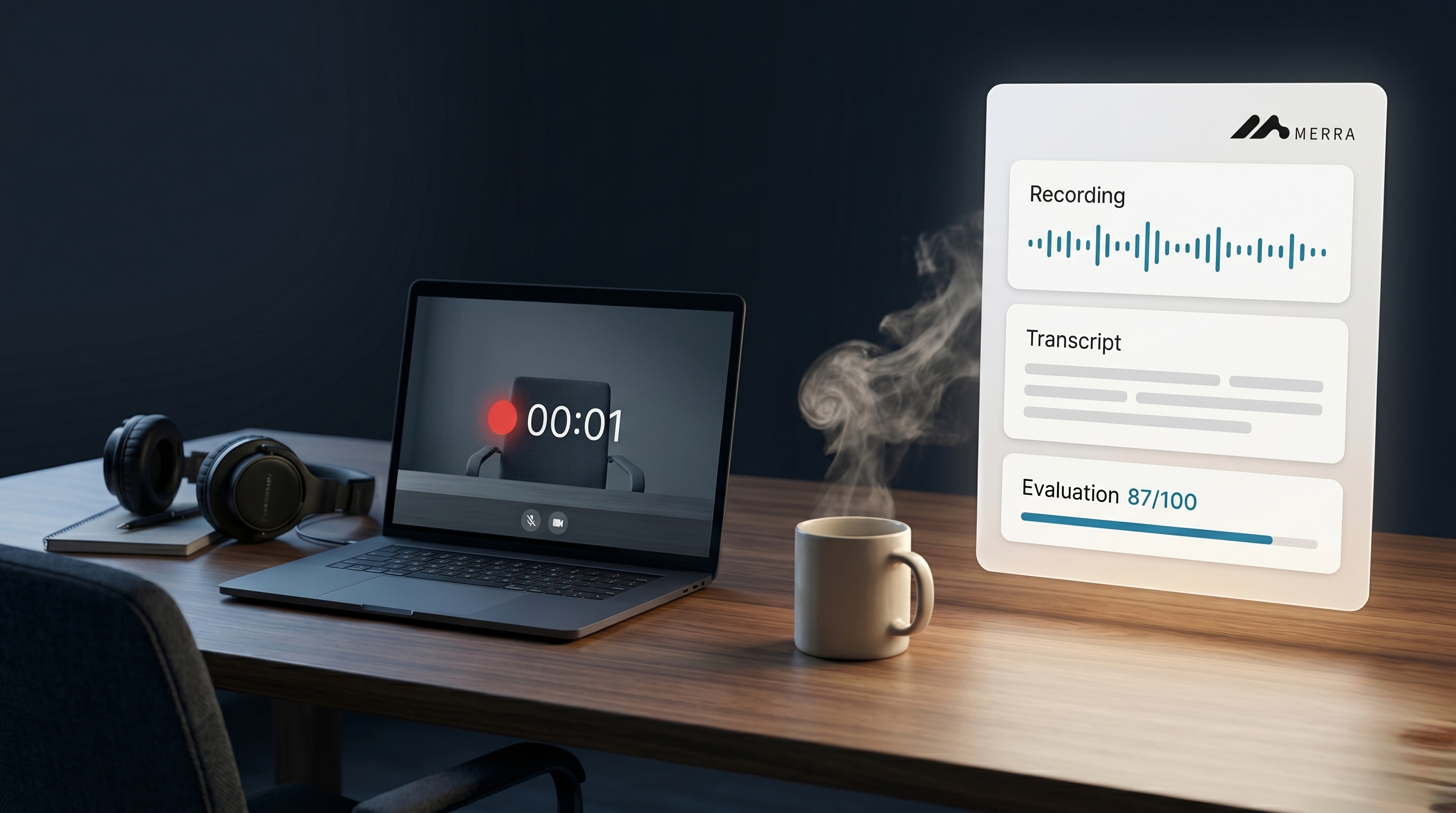
Why we killed the one-way video interview at Merra and built something else
CVs give you claims. One-way videos give you performances. Neither gives you evidence. Why we replaced both with conversational, evidence-based first-round screening on every applicant.
 AI in Hiring
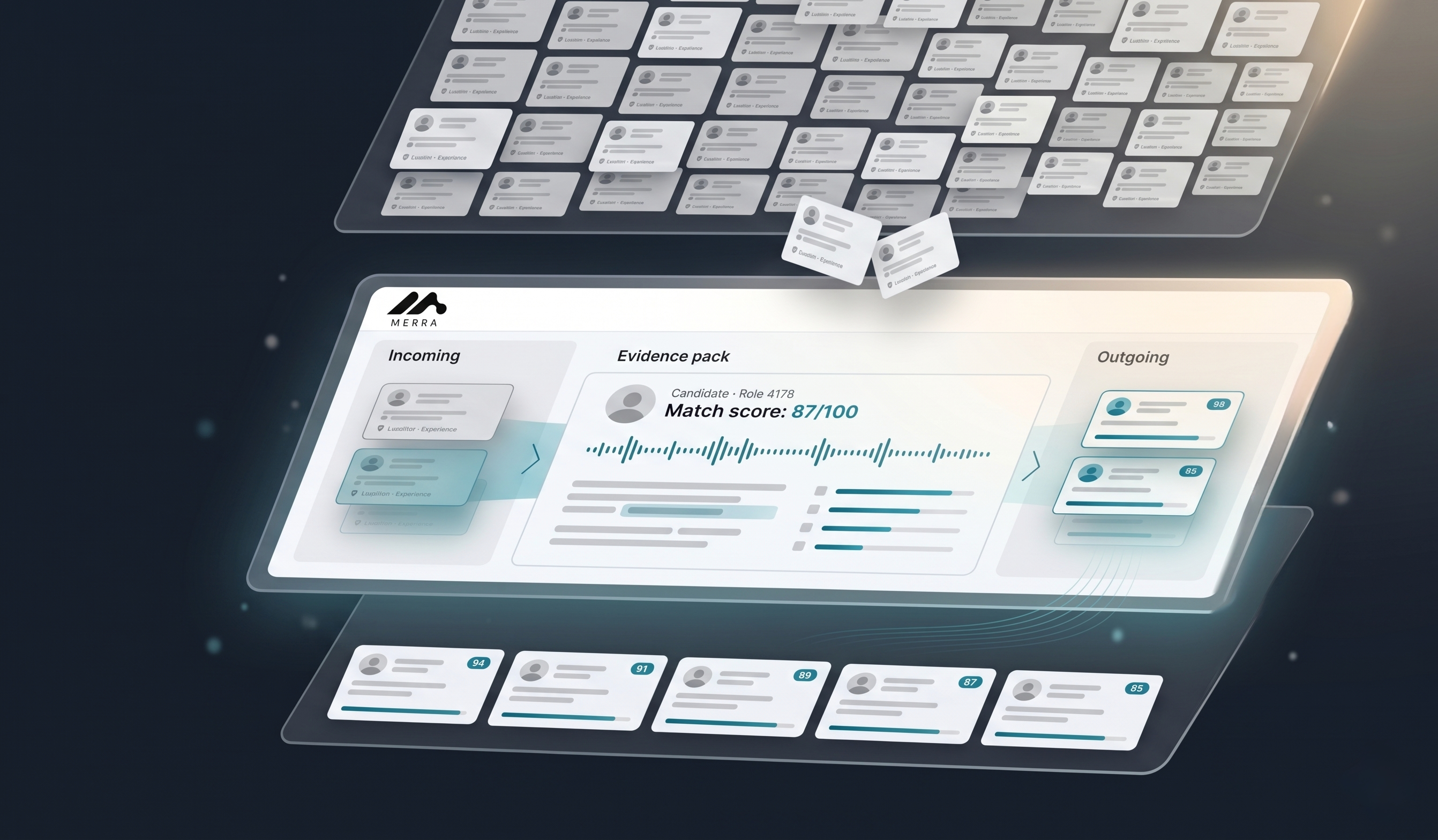
How AI is transforming the hiring process in 2026
Most '2026 hiring' posts run on hype. Here's what's actually changed, what hasn't, and how to evaluate AI interviewing tools — from a founder building one.