How AI is transforming the hiring process in 2026
Most '2026 hiring' posts run on hype. Here's what's actually changed, what hasn't, and how to evaluate AI interviewing tools — from a founder building one.
Three things every "2026 hiring" post gets wrong
If you've read more than one of these in the last six months you've seen the same three claims, usually unsourced.
Claim 1: "AI cuts time-to-hire by 70%." Sometimes 50%, sometimes 80%, never with a methodology. Time-to-hire is a useful metric, but cutting it without changing anything else is just compressing the same noisy process into a shorter window. If your scoring is bad and your rubric doesn't exist, hiring faster means hiring badly faster.
Claim 2: "AI removes bias from hiring." Partly true and mostly oversold. Structured interviewing — same questions, same rubric, multiple evaluators — does reduce bias compared to unstructured human interviews. That is what the research has said for forty years. AI is one way to make structured interviewing happen at scale. AI itself is not the source of fairness. A bad rubric plus AI scoring will produce confidently biased results, audited and timestamped.
Claim 3: "AI is going to replace recruiters." Wrong frame. The recruiters who win in 2026 won't be replaced — they'll be running ten times the volume with the same headcount, because the screening floor is automated, the evidence pack is in the ATS, and they get to spend their time on offers, references, and difficult judgement calls rather than calendar tetris.
The interesting question for 2026 isn't "is AI changing hiring" — obviously yes. The interesting question is which parts, and where the framing breaks.
What's actually changed
Three real shifts. None of them are about speed.
Shift 1: Capacity. Every applicant can now get a real first-round.
For decades, the maths of first-round screening has been ugly. A senior recruiter can run roughly 30–40 first-round phone screens a week before the work degrades into noise. A team of five covers 150–200. Anything above that — which is most inbound funnels for any role with public visibility — gets triaged by CV scan.
CV triage isn't first-round screening. It's a guess about who might be worth a first-round, made on the weakest possible signal: a self-authored document the candidate spent four hours optimising for keyword scanners.
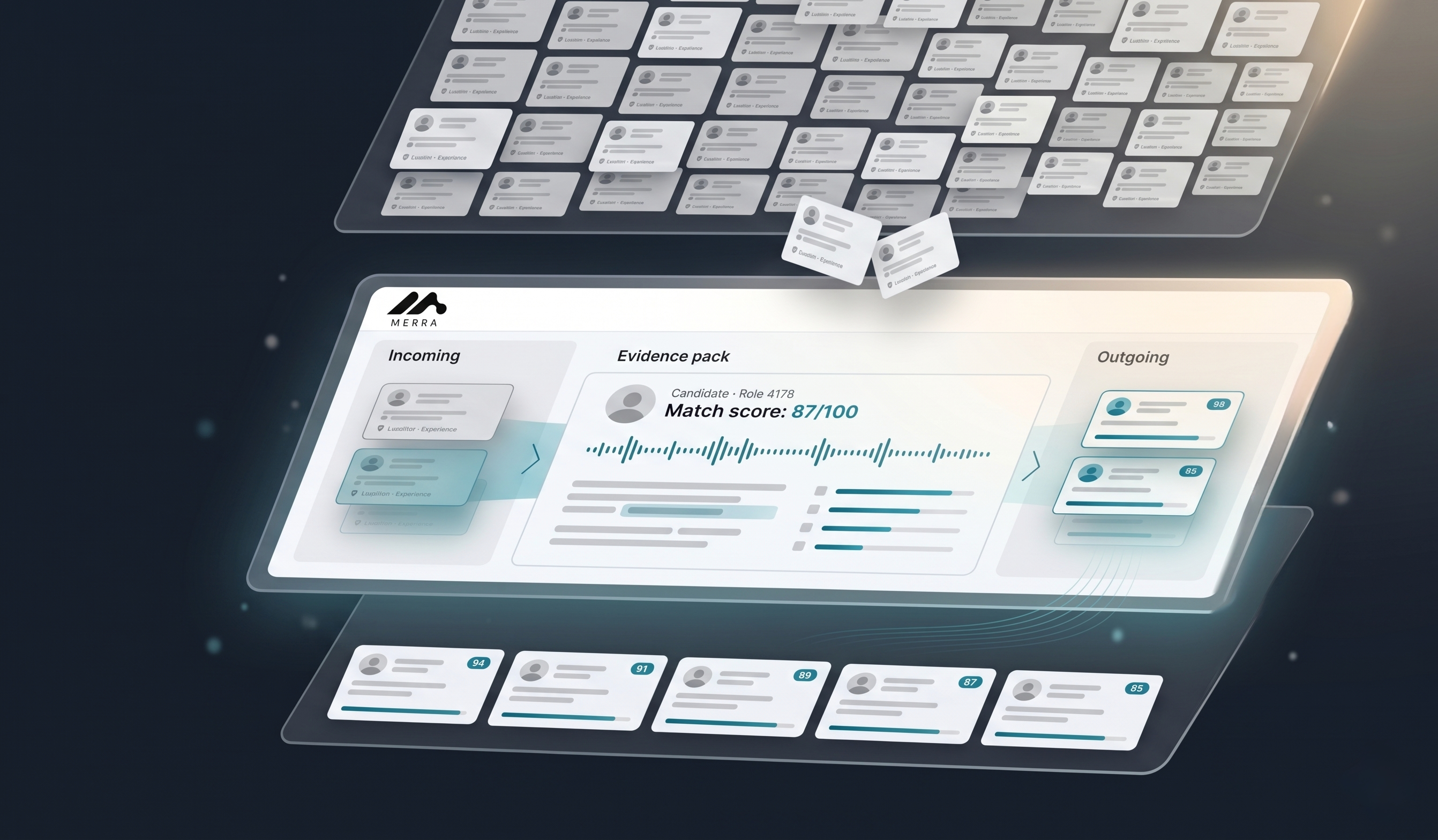
What's actually changed in 2026 is that the floor of "every applicant gets a structured first-round conversation" is now operationally possible. Not a one-way recorded monologue. Not an automated email. A real structured conversation, recorded and transcribed and scored against the same rubric every time. At inbound volumes that previously required either a forty-person screening team or a CV-scan triage layer.
This is the change. Everything else is downstream of it.
Shift 2: Format. The CV + one-way video stack is being replaced with conversation + evidence.
The CV gives you claims. A one-way video gives you a thirty-second monologue rehearsed twelve times before submission. Neither gives you evidence of how the candidate thinks under pressure, how they handle a follow-up question, or how they describe their work when they're not reading from a prompt.
The format that does give you that signal is a conversation — same questions across every candidate, same rubric, follow-up probes when an answer is too smooth. Forty years of personnel-selection research (Schmidt and Hunter's meta-analysis, replicated and updated) shows structured interviews are the highest-validity hiring signal a team can produce without a research department: a validity coefficient of around 0.51, roughly twice that of unstructured interviews. Google's Project Oxygen showed the same effect inside a single company — structured interviews are about 2× more predictive of on-the-job performance than unstructured ones, even when run by the same interviewer.
What's new in 2026 isn't the research. It's that AI interviewing platforms can deliver this format at the volume of your real funnel — not just to the top 10% who survived CV triage. The format is the same; the volume is the change.
Shift 3: Evidence. Audit trail by default, not by exception.
The third change is the quietest and the most important. In 2024, "we have a recording and transcript of the interview" was a premium feature, used by enterprise teams with a compliance budget. In 2026, it is the default for any AI-run first round. Recording, transcript, structured evaluation, decision summary — produced for every candidate, available six months later when someone asks why a candidate was passed over.
This matters for three reasons. First, it makes hiring decisions auditable, which is increasingly a legal requirement in the EU and several US states. Second, it makes hiring decisions improvable: you can go back to the data and check whether your rubric is actually predicting performance. Third, it makes hiring decisions defensible — to the candidate, to the team, to the eventual lawsuit.
The evidence pack is the second-order change. The structured interview gives you the signal. The evidence pack lets you trust it.
What hasn't changed
Five things the marketing wants you to forget.
The rubric still has to be designed by humans. AI doesn't know what a good engineer looks like at your company. You do. If your rubric is bad — vague competencies, undefined scoring scales, no behavioural anchors — AI will score against a bad rubric, consistently and fast.
The job description still has to be honest. AI screening on a job description that doesn't reflect the actual job will produce a perfectly ranked list of candidates for the job you're not hiring for.
Reference calls still matter. A structured AI interview gives you signal on candidate self-presentation. References give you signal on observed behaviour over time. Different sources, both useful, neither replaceable.
The offer decision is still human. AI screening produces evidence and a ranked shortlist. The hiring manager picks who to hire. That part isn't going anywhere, and shouldn't.
Fairness still has to be designed in. Auditable evidence is necessary but not sufficient. If your rubric scores "communication style" without defining it, you've automated a bias, not removed it.
The one-line version: AI changed who gets a first round. It didn't change what good hiring looks like.
Where the lazy narrative breaks
Four places to watch out for in 2026, if you're evaluating AI hiring tools or reading vendor pitches.
"Time-to-hire" without methodology. Cutting time-to-hire from 30 days to 9 is meaningless if the underlying scoring is worse. Always ask how the platform validated its scoring against on-the-job performance, not just against speed. If the only published metric is speed, the platform is selling a stopwatch, not a hiring tool.
"X% improvement in quality of hire." Quality of hire is one of the least standardised metrics in HR. Some teams measure it as 90-day retention, some as performance-review score at 12 months, some as hiring-manager satisfaction (which measures the manager's confidence, not the hire's performance). Always ask the vendor: measured against what, on what timeline, with what control group?
"Bias-free AI." No AI is bias-free. The honest claim is bias-audited AI: rubric reviewed by humans, scoring outputs audited for adverse impact, decisions reviewable by case. If a vendor tells you their AI is bias-free, they either don't know what bias means or they're hoping you don't.
"Replaces your recruiting team." Recruitment is offers, references, candidate experience, hiring-manager calibration, intake meetings, comp negotiation, and forty other jobs that aren't first-round screening. The honest claim is automates first-round screening so your recruiters can do the rest. Tools that promise to replace recruiters are either lying or building for a customer who shouldn't be hiring at all.
What to actually do in 2026
Five concrete moves, in order, for any TA team evaluating AI hiring tools this year.
Pick one high-volume role. Not the senior leadership search, not the niche specialist. A role you hire repeatedly — SDR, customer support, junior engineering, first-line operations. High volume is where AI's capacity advantage shows up; on a single senior search it's overkill.
Define the rubric before you turn AI on. Six to ten competencies, with behavioural anchors at score 1, 3, and 5. Reviewed by the hiring manager and at least one person who actually does the job. This is the work AI cannot do for you, and it's the single biggest determinant of whether AI scoring will help or hurt.
Run AI on every applicant for that role, not a subset. The whole point of capacity is that you no longer need to triage who gets a first round. If you're still running CV triage and only AI-screening the survivors, you've kept the bottleneck.
Score human judgement on the shortlist, with the AI evaluation visible. Hiring managers and recruiters review the AI-ranked shortlist with full access to recording, transcript, and rubric scoring. Their job is to disagree with the AI when they have a reason — recorded reason, not gut feel — and select who advances.
Audit the evidence pack quarterly. Pull a sample of advanced candidates and a sample of rejected candidates. Were the rejection reasons defensible? Was the AI scoring consistent across demographic groups? If you can't audit it, you can't trust it.
What this looks like at Merra
Honest disclosure: I run an AI interviewing company. We do exactly what's described above. Every applicant for the roles you set Merra on gets the same structured first-round conversation — the questions you choose, the rubric you choose, recording, transcript, and scored evaluation per candidate. Your recruiters get a ranked shortlist and the evidence pack underneath each ranking, in your ATS, six months later when someone asks why.
We're opinionated about a few things. Recording on every applicant, not just the shortlist. Same rubric across every candidate for the same role, version-controlled and audit-ready. Human review of the shortlist, not a "fully automated hire" workflow. And no "70% time-to-hire reduction" claims on this site, because that's the kind of number that means whatever the vendor wants it to mean.
If that sounds like the right shape for one of your roles, the offer is the same as in any post on this site:
Run a pilot on one role and see the evidence pack Merra gives your team.
FAQ
Is AI hiring biased?
AI hiring is biased to the degree that its training data, rubric, and scoring rules are biased. The right framing isn't "AI removes bias" — it's "AI makes hiring decisions auditable, which lets you find and fix bias you couldn't see before." The single most important step is rubric design: vague competencies will produce confidently biased scores. Specific, behaviourally anchored competencies, audited quarterly for adverse impact, will give you a hiring process that is more defensible than the human-only version it replaced.
How do I evaluate an AI interviewing platform?
Seven questions: (1) Does it run on every applicant or only a triaged subset? (2) Does it produce a recording, transcript, and scored evaluation per candidate? (3) Is the rubric configurable to your roles, or fixed? (4) How does the platform validate its scoring against on-the-job performance — not just speed? (5) Is the evidence pack accessible six months later for audit? (6) Does it integrate with your ATS, or sit beside it as a separate tab? (7) Has it been audited for adverse impact? Our buyer's guide for TA leaders covers all seven in detail.
Will AI replace recruiters in 2026?
No. AI is replacing the first-round screening floor — the part of recruiting that was always running into capacity walls. The rest of the recruiter's job (offers, references, hiring-manager calibration, candidate experience, comp negotiation) is still human, still skilled, and now happens with better signal because the front-of-funnel is no longer triaged by CV scan.
What's the right first role to pilot AI hiring on?
A role you hire repeatedly and at volume. SDRs, customer support, junior engineering, first-line operations, contact-centre. Avoid senior leadership searches and niche specialist roles for the first pilot — they don't have the volume to show the capacity advantage, and they have idiosyncratic evaluation criteria that work better with bespoke human screens.
How do I measure whether AI hiring is working?
Three metrics, on one role, before-and-after: (1) Percentage of applicants who got a structured first-round conversation. Most teams move from 5–15% (CV-triaged) to 100%. (2) Hiring-manager confidence in the shortlist. Survey-based, before they meet candidates. (3) 90-day retention and performance-review score at 6 months for hires made through the AI process versus your previous baseline. Ignore time-to-hire as a primary metric. It's the easiest number to move and the least reliable.
Ahmed Ghelle is the founder of Merra, an AI interviewing platform that runs structured first-round interviews on every applicant and produces a recording, transcript, and scored evaluation for each one. He writes about hiring, evidence, and the difference between speed and signal.
Ready to ace your next interview?
Practise realistic mock interviews with conversational AI and get actionable feedback. Start with a free interview.
Start your free interviewsKeep reading
 AI in Hiring
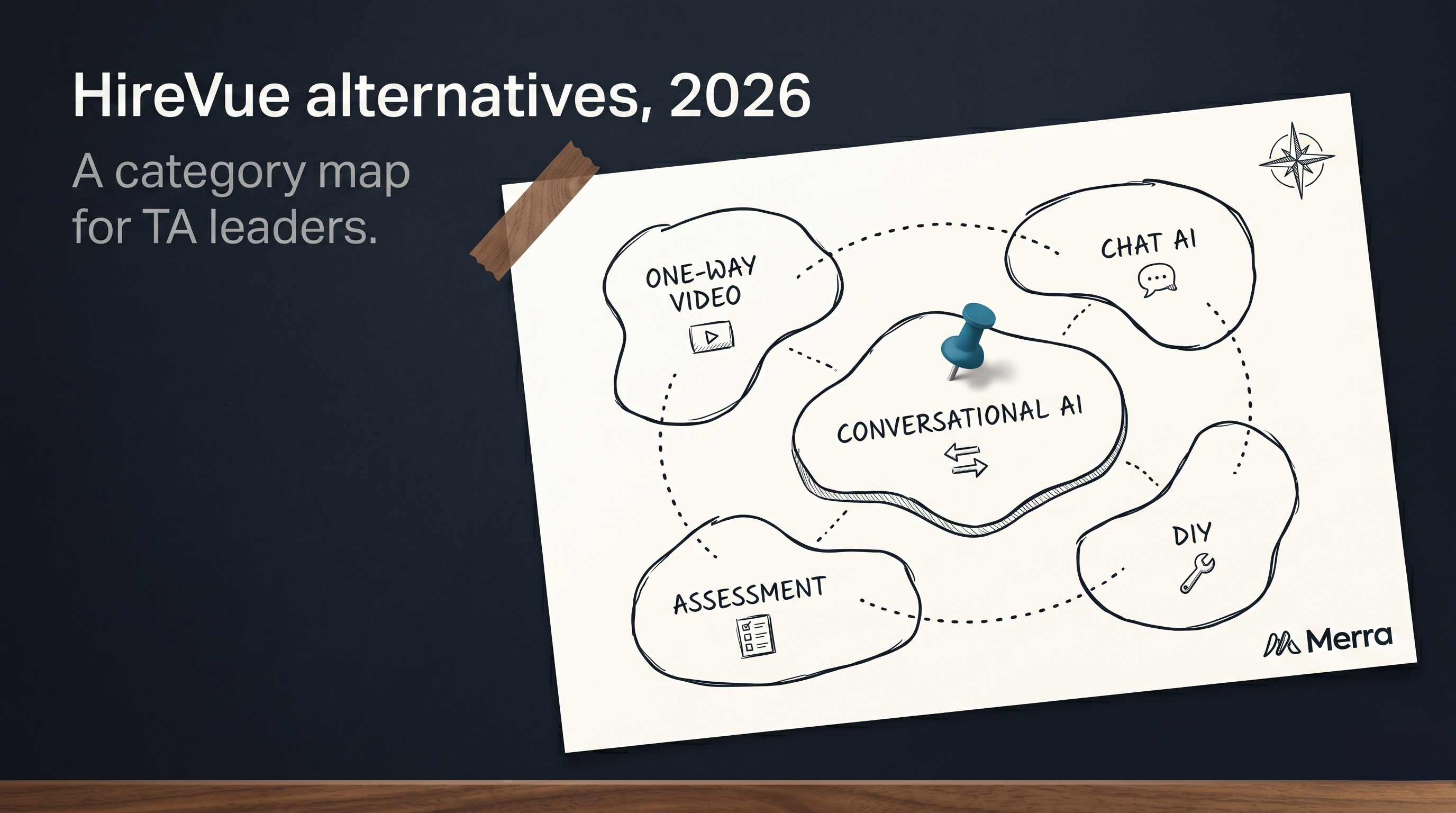
HireVue alternatives for 2026: a category map for TA leaders
"HireVue alternatives" is the most-searched buyer query in AI hiring software. Here are the five real categories of answer in 2026, and how to pick the right one for your team.
 AI in Hiring
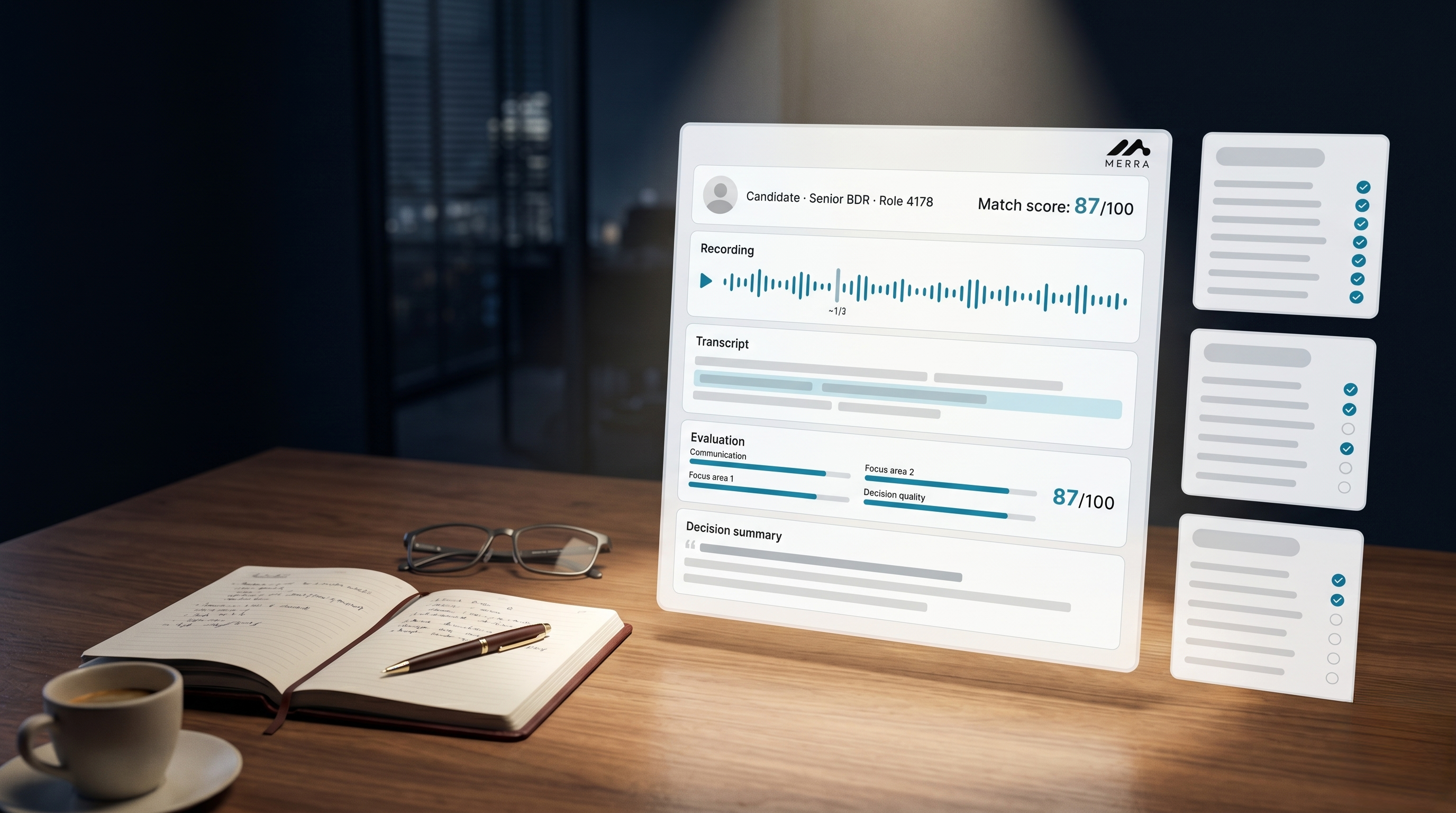
AI screening software: a buyer's guide for TA leaders
Most AI screening tools sell speed. The ones worth buying produce evidence. Here are the seven questions every TA leader should ask before signing a contract.
 AI in Hiring
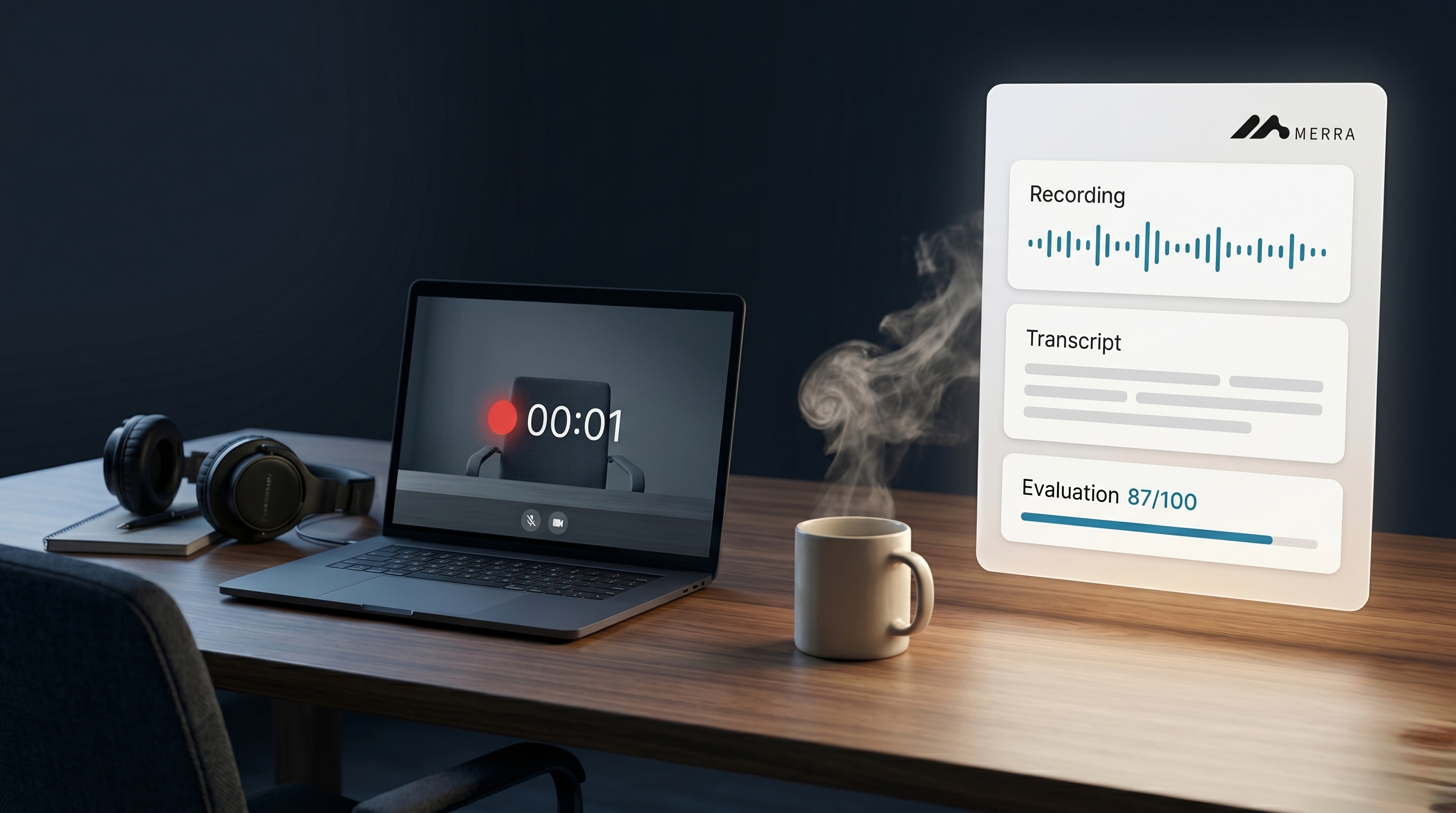
Why we killed the one-way video interview at Merra and built something else
CVs give you claims. One-way videos give you performances. Neither gives you evidence. Why we replaced both with conversational, evidence-based first-round screening on every applicant.