10 Common AI Interview Questions and How to Answer Them
The 10 questions you'll actually get asked in an AI interview - what each one scores, the weak answer pattern to avoid, and the strong structure that lands. With example answers and a way to practise.
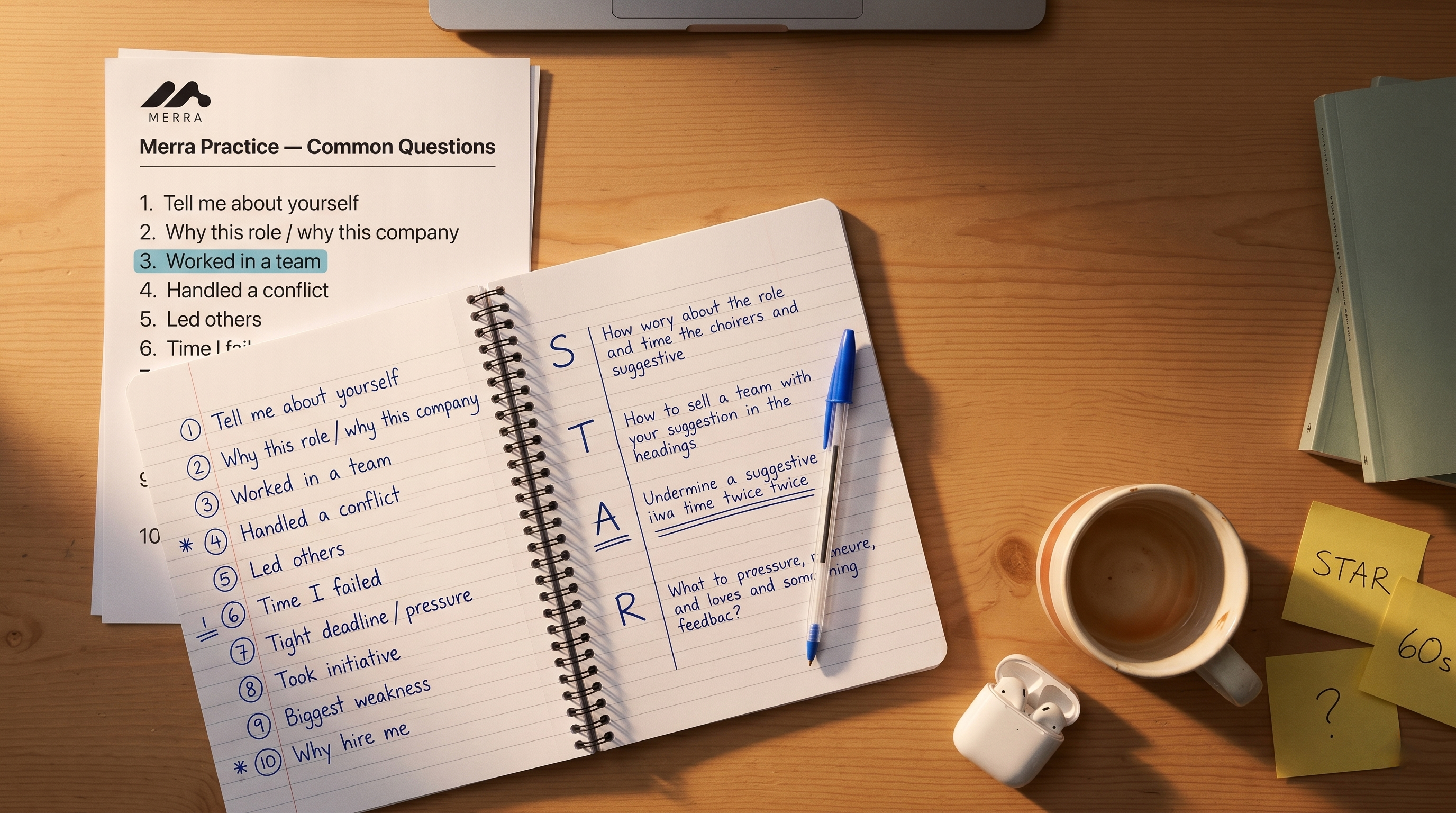
Most AI interview prep content gives you a list of 50 questions, wishes you luck, and disappears. That's not useful. The same 10 underlying questions get asked in different wrappers in almost every behavioural AI interview a graduate or early-careers candidate will face. "Tell me about a time you led a team", "a time you took ownership", and "a time you stepped up" are different doors into the same evidence. Learn the 10, build one strong answer for each, and you've prepped for almost every real interview.
One more thing worth knowing upfront: behavioural AI interviews - whether you're facing HireVue, Sapia, Paradox, or any conversational interview built on a similar engine - score the transcript of what you say, against a list of competencies the employer cares about. HireVue, for example, stopped using facial analysis in 2021 and now scores transcripts only. Sapia and Paradox are text-based by design. So for most of these interviews, what gets scored is the words, not the face. So every weak answer below has the same root cause: the words don't carry the evidence the AI is looking for.
Here are the 10.
1. Tell me about yourself
What the AI is scoring: Whether you can structure a 90-second self-introduction without rambling, and whether what you've done so far points coherently at the role you're applying for. This is the easiest question to answer badly because most people treat it as casual chat.
Weak answer pattern: Born-and-raised autobiography. "I grew up in Manchester, then I went to..." It burns your time, drowns the recruiter in irrelevant detail, and signals you don't know what to prioritise.
Strong answer structure: Present → Past → Future. One sentence on what you're doing now (degree, year, focus). Two sentences on the most relevant 1–2 things you've done that point at this role. One sentence on why this role is the obvious next step.
Example: "I'm a final-year Business Management student at Warwick, specialising in operations. Last summer I interned on the supply-chain team at Tesco and ran a project that cut our restock cycle by two days - which got me hooked on how decisions made at HQ actually land in stores. I'm applying for the Tesco grad scheme because I want to keep doing that kind of work, but across the wider business."
2. Why this company / why this role?
What the AI is scoring: Whether you've done specific research, and whether your answer is genuinely about this company - not a paragraph you could paste into any application.
Weak answer pattern: Praise that fits any company. "I love your values, your mission, your innovative culture..." If you could swap the company name with a competitor and the answer still works, you've lost.
Strong answer structure: One specific thing they do that you actually find interesting → why that connects to something you've already done or believe → what you'd want to learn from being inside the company. Three sentences. Concrete.
Example: "I've been following PwC's Operate work because it's one of the few places combining audit-grade rigour with actual tech delivery - and that combination is what I tried to build in my final-year project automating a charity's expense reporting. I'd want to learn how a team at scale runs that kind of work end-to-end, and the graduate programme is the cleanest way in."
3. Tell me about a time you worked in a team
What the AI is scoring: Whether you can describe team work where your specific contribution is clear. Lots of candidates say "we" so much the AI can't tell what they personally did.
Weak answer pattern: "We" for the whole story. "We won the case competition, we presented to the judges, we wrote the report." The AI can't score what you did.
Strong answer structure: Brief team setup → the specific role you took → one decision you made or action you led → the team result, with your contribution made visible.
Example: "I was one of four on a consultancy society case team in second year. Two days in, we were still arguing about the market sizing. I built a quick Excel model that let us test three different assumptions in 20 minutes so we could move on. We placed second in the final out of 40 teams, and the model became the team's working method for the rest of the year."
4. Tell me about a time you handled a conflict or disagreement
What the AI is scoring: Whether you can handle disagreement without making the other person the villain, and whether you actually resolved it - not just survived it.
Weak answer pattern: "There was this difficult person..." Painting the other party as unreasonable, with you as the calm hero. The answer doesn't show how you handled the disagreement, just how you tolerated it, which is what the question is actually asking about.
Strong answer structure: Set up the disagreement neutrally (both sides had a point) → what you did to understand the other side → what you proposed → the resolution and what changed.
Example: "On a group project I was running the analysis, and a teammate wanted to swap the methodology two days before the deadline. My first reaction was no. I asked her to walk me through her reasoning, and she had a point - our original approach was missing a key control. We agreed to use my analysis as the main result and her approach as a sensitivity check, so we didn't blow up the timeline but we covered the gap. We got a 78."
5. Tell me about a time you led others
What the AI is scoring: Leadership without a title. Did you take responsibility for an outcome and bring people with you, or did you just have "captain" on a CV bullet?
Weak answer pattern: Just listing the title. "I was president of the society." That's a role, not a story.
Strong answer structure: The situation that needed leading → what you decided to do that wasn't being done → how you got others on board → what changed because you stepped up.
Example: "I was treasurer of our entrepreneurship society and we'd lost two sponsors before term started. I didn't have a formal mandate to do outreach, but I drafted a new sponsor brief, got the committee's sign-off, and split a list of 30 local businesses between me and three other members. We landed four new sponsors and ran our flagship event with a bigger budget than the year before."
6. Tell me about a time you failed or made a mistake
What the AI is scoring: Honesty about a real failure plus what you actually changed afterwards. The competency the question is checking is self-awareness, so "humble brags" (failures that are secretly strengths) and unfixed failures both miss the point.
Weak answer pattern: The fake failure. "I work too hard sometimes." Or the unfixed failure - describing what went wrong and never saying what you learned.
Strong answer structure: A real mistake with real cost → what you did wrong specifically → what you changed in your approach → evidence that the change held.
Example: "In my first internship I sent a client deliverable without getting it peer-reviewed because I was running late. There was a small data error my line manager caught after the client had already opened it. I had to send a correction email, which was embarrassing. After that I built a 5-line checklist I now run before sending anything client-facing - I used it for the rest of the internship and I've used it on every freelance project since."
7. Tell me about a time you worked under pressure or to a tight deadline
What the AI is scoring: Whether you can describe pressure without exaggerating it, and whether you have a system for what to do when time is short - not just a story about staying up late.
Weak answer pattern: "I just pulled an all-nighter." Suffering is not a strategy.
Strong answer structure: What was at stake plus the actual time constraint → how you decided what to cut and what to keep → the result and what you'd do differently if it happened again.
Example: "In second year I had two essays and a group presentation due in 72 hours. I sat down on the Sunday morning and ranked them by weight in the module mark, then time-blocked the rest of the weekend backwards from the deadlines. The presentation got the most prep time because it was 40% of the mark. I'd do the ranking earlier next time - I lost most of Saturday to deciding which order to do things in."
8. Tell me about a time you took initiative
What the AI is scoring: Whether you can name something you started that wasn't asked of you - and whether the outcome justified the initiative, or whether you just made extra work for someone.
Weak answer pattern: Disguising assigned work as initiative. If your manager told you to do it, it isn't initiative.
Strong answer structure: A problem you spotted that no one had asked you to fix → why you decided to act → what you actually did → the outcome, and what someone else did with it after you left.
Example: "On my internship I noticed our team's weekly KPI report was being assembled manually every Friday and taking three hours. I built a Google Sheets template that pulled the numbers from the source dashboards automatically. I asked my manager to sanity-check it, then handed it off. It's still being used now - the new intern doesn't have to do the manual version at all."
9. What's your biggest weakness?
What the AI is scoring: Self-awareness plus evidence you're actively working on it. Both halves matter.
Weak answer pattern: The disguised strength. "I'm a perfectionist." / "I care too much." The question is asking for self-awareness, and a disguised strength doesn't show any.
Strong answer structure: A real weakness that's plausible for someone at your stage → a concrete example where it cost you → one specific thing you've started doing to work on it.
Example: "I'm not great at saying no to extra projects, which has bitten me. Last term I took on a research assistant role on top of two society commitments and my own coursework, and the research role suffered because I'd over-committed. Since then I've set a rule that I write every commitment down in one place before I say yes to a new one - it's slowed me down enough to actually weigh it."
10. Why should we hire you? / What sets you apart?
What the AI is scoring: Whether you can summarise your fit in 60 seconds without sounding arrogant or weak. This is often the closing question, so it's also testing whether you can land an interview cleanly.
Weak answer pattern: Recycling generic strengths. "I'm hard-working, I'm a team player, I'm passionate." Says nothing about you.
Strong answer structure: One thing you've done that's directly relevant + one trait that's been tested under real conditions + a clean closing sentence about why this specific role is where you'd apply it.
Example: "I've already done the kind of analytical work this role asks for - the supply-chain project I ran at Tesco showed me I can take a messy data problem and turn it into a recommendation that gets actioned. And I learned during that project that I do my best work when I have a clear deliverable and freedom on the method. That's exactly the setup the grad scheme runs, which is why I want it."
How to actually practise these
Reading the list isn't practice. Writing example answers isn't practice either. Practice means saying the answers out loud, getting interrupted, and finding out which ones fall apart under follow-ups.
Two-step practice loop:
Build your story bank first. Most of these 10 questions point back to the same 6 underlying stories from your life. Map them out: which project covers conflict, leadership, and pressure? Which one covers initiative and failure? You should be able to answer most behavioural questions out of a 6-story library. (More on building a story bank, plus the full prep plan, is in the AI interview practice hub.)
Run the full set on Merra Practice. Three routes depending on what you know about the role:
Amazon, Microsoft, Deloitte, PwC or KPMG: open that employer's tile in Top Company Prep and pick the role closest to yours - the interview is tuned to how that employer actually interviews.
Any other employer: use the Custom Interview option. Paste in the job title, level, the JD, and (if you can find them on Glassdoor or the careers subreddit) the specific behavioural questions you're expecting. Merra runs the whole thing as a tailored mock of that exact role.
Don't know the role yet: pick the Graduate / Early Careers interview type and choose the closest role family.
When you start, Merra asks whether you want Coach mode or straight Interview mode for that session. Run the practice twice. First in Coach mode - feedback on each answer in real time, room to redo and tighten the story. This is where you build the answers. Then in Interview mode - straight questions with real follow-ups, no pauses, no resets, the way a recruiter would push you. This is where you find out which of your 10 answers actually hold up.
Merra Practice is built on the same interview engine we built for employer-side first-round screening, so you're practising against the kind of AI that increasingly sits behind these interviews on the recruiter side.
Run the practice
🎯 Run a free AI practice interview on Merra Practice and get feedback before the real one counts.
Ahmed Ghelle is the founder of Merra, an AI interviewing platform that runs structured first-round interviews on every applicant and produces a recording, transcript, and scored evaluation for each one. He writes about hiring, evidence, and the difference between speed and signal.
Ready to ace your next interview?
Practise realistic mock interviews with conversational AI and get actionable feedback. Start with a free interview.
Start your free interviewsKeep reading
 Interview Tips
Interview Tips for 2026: How to Prepare, Answer Well and Make a Strong Impression
Practical interview tips for 2026: how to prepare stories, answer clearly, handle nerves, read the room, ask better questions and follow up after in-person, video or panel interviews with confidence.
 Interview Tips
How to Pass an AI Interview: 7 Things Candidates Get Wrong
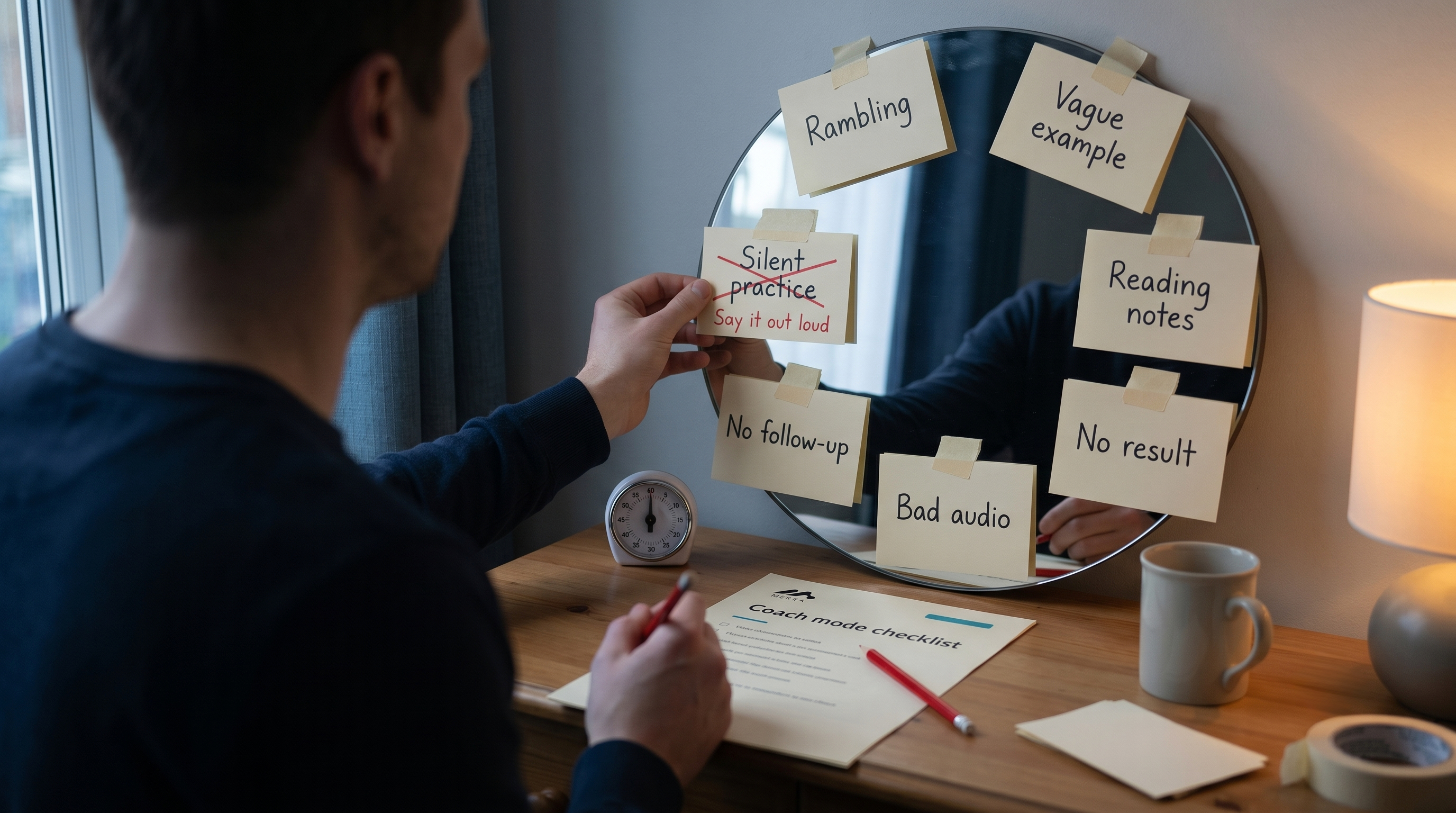
Learn how to pass an AI interview in 2026 - seven mistakes candidates make, from rambling and weak examples to reading notes, poor setup and never practising out loud before the real interview starts.
 Interview Tips
How Long Should AI Interview Answers Be? The 60 to 90 Second Rule
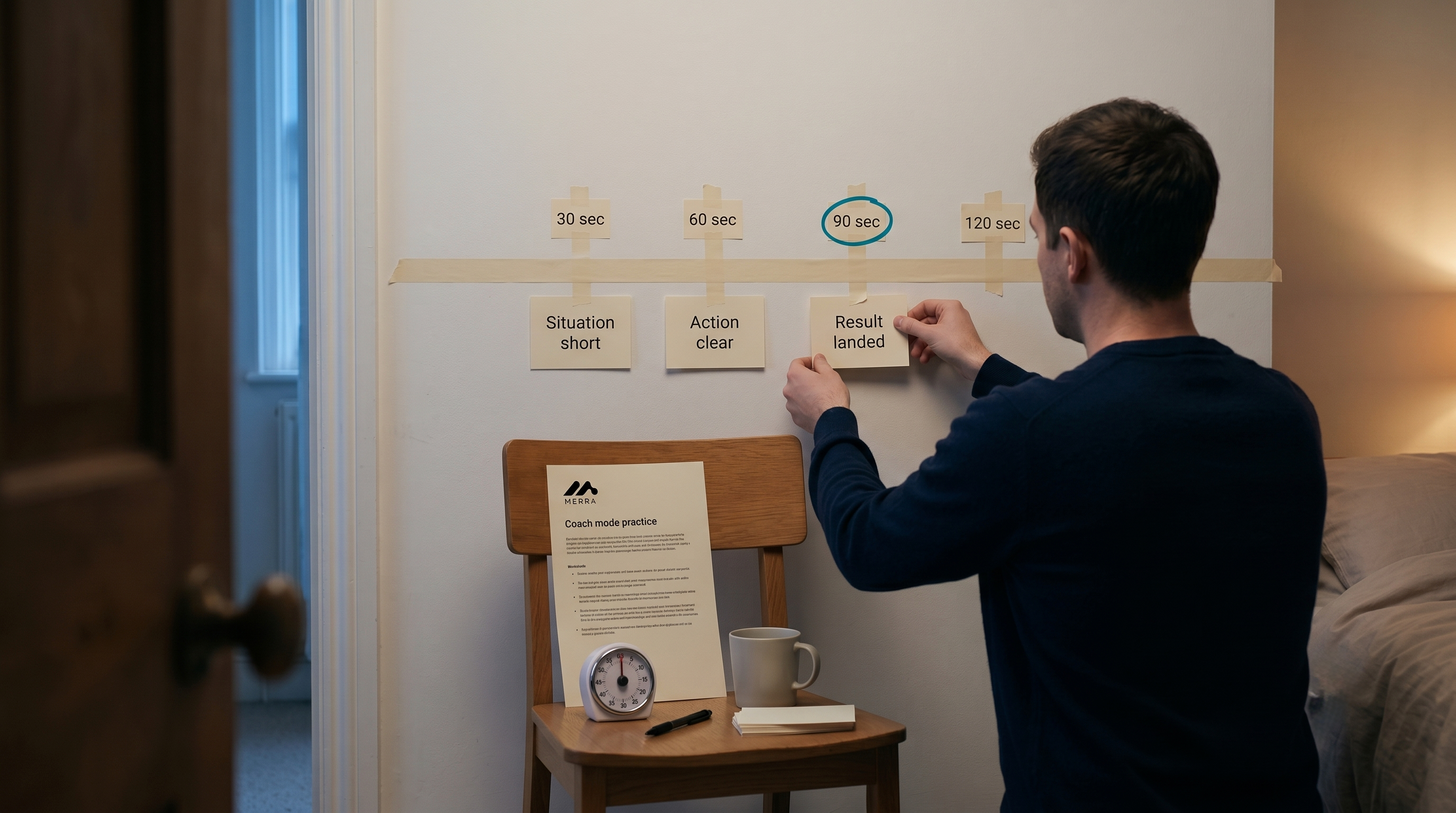
Learn how long AI interview answers should be in 2026: when to use 30, 60, 90 or 120 seconds, how to pace STAR answers, avoid rambling and practise timed replies before the real interview starts now.