How to prepare for an AI interview: the practice guide for students and graduates
AI interviews are the new first round. Here's what they really test, where most candidates lose marks, and exactly how to practice before yours.
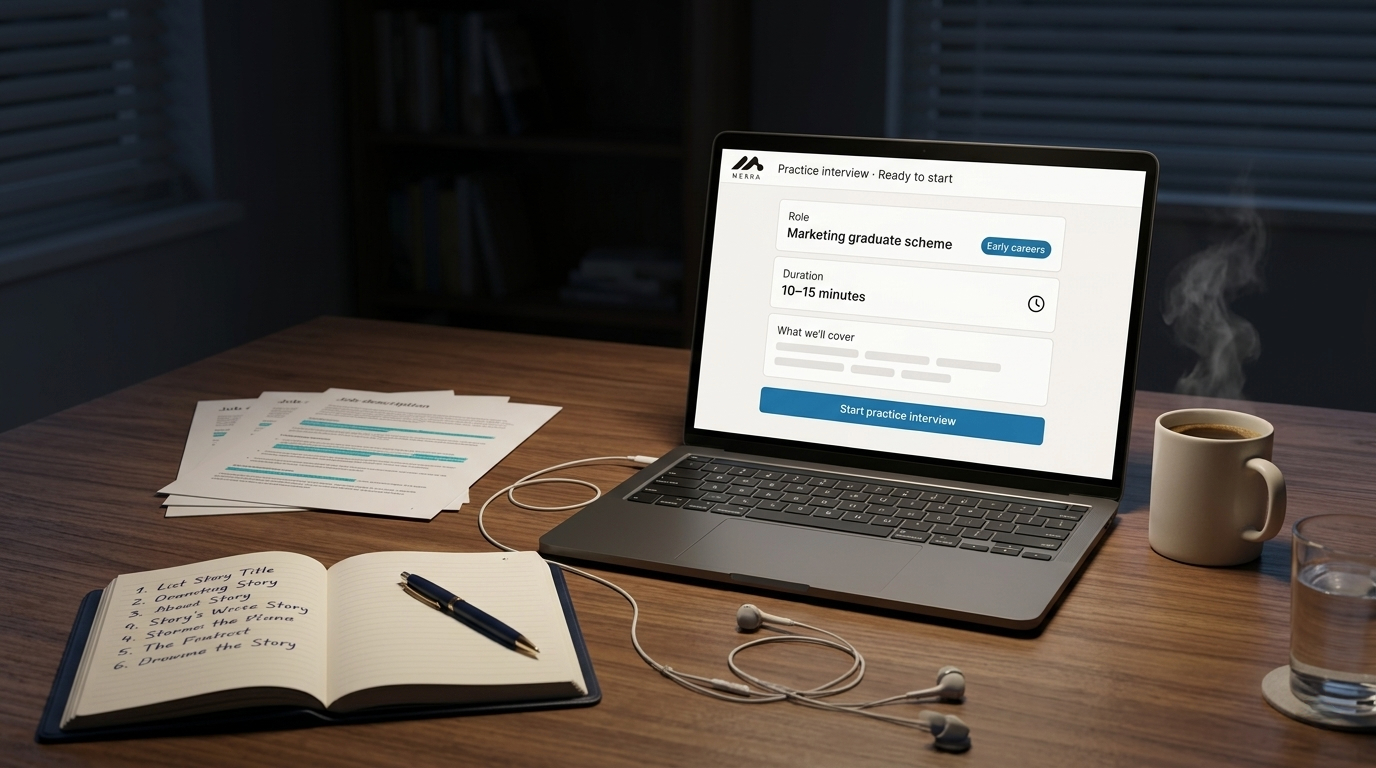
Who this guide is for
If you've just applied for an internship, a graduate scheme, or your first early-career role and the email that came back says something like "the next step is a short AI video interview" or "please complete your interview within the next 5 days" — this is for you.
You are not being filtered out. You are being interviewed. The difference matters, and most candidates don't realise it.
This is the same guide we'd give a friend who got the email two days ago and is starting to panic. No fluff, no "believe in yourself" filler. Just what AI interviews actually are, what they look for, and how to be ready.
First, what an AI interview actually is
The phrase AI interview now covers three genuinely different things. Before you prepare, work out which one you've been invited to. The preparation is different for each.
Shape 1 — One-way video interview (the old format)
You get a list of pre-set questions on screen. A timer counts down. You record yourself answering each one into your webcam. No one is on the other side. A recruiter (or an AI) watches the recording later.
How it feels: stiff, awkward, like talking to a wall. There's no follow-up — once you've answered, you move on.
Examples: HireVue (classic mode), Spark Hire, VidCruiter, Willo, Hireflix.
Shape 2 — Conversational AI interview (the new format)
An AI interviewer talks to you in real time. It asks a question, listens to your answer, then asks a follow-up based on what you actually said. It probes when your answer is vague. It moves on when you've given enough. The whole thing lasts 10–15 minutes and feels like a real first-round call with a recruiter — just with an AI on the other side.
How it feels: much closer to a normal conversation. Lower pressure than a one-way video. You can pause, think, and even ask the AI to repeat the question.
Examples: Merra (this is the category we built), Paradox, Sapia, HireLogic, and an increasing number of large employers building this in-house.
Shape 3 — AI-scored live interview
You're on a video call with a real human recruiter, but an AI is listening in, transcribing, and scoring you in the background. The recruiter sees the AI's notes after the call.
How it feels: like a normal interview. You probably won't even know the AI is there unless the company tells you — and in places like New York City (under Local Law 144), the EU (under the AI Act), and the UK (under ICO guidance), companies are typically required to disclose it.
A growing share of early-career and high-volume roles in 2026 use Shape 1 or Shape 2 for the first round. The rest of this guide focuses on those two. If you have a Shape 3 interview, prepare exactly the way you'd prepare for any human interview — the AI in the background doesn't change what makes a good answer.
What the AI is actually testing
This is the part most candidates get wrong. They prepare for an AI interview like it's a personality test, a memory exam, or a search for the perfect answer.
It isn't any of those.
A well-built AI interviewer is doing four things:
Listening for evidence. Not opinions, not slogans. Actual examples of things you've done, decisions you've made, problems you've solved.
Probing when you're vague. If you say "I'm a strong communicator," a decent AI interviewer will ask "can you give me a specific time you had to communicate something difficult?" It is hunting for the story underneath the claim.
Comparing across candidates structurally. Every applicant for that role gets the same focus areas. The AI scores you against those areas, not against the previous candidate. There is no "too many strong candidates today, sorry."
Building a record a human will read. At the end, a recruiter opens your file and sees the recording, the transcript, and a structured evaluation. They are not reading every word — they are scanning for the moments you stood out (or didn't).
Notice what's not on that list: charisma, polish, perfect grammar, a quiet room, an expensive setup, or an extroverted personality. The AI is measuring substance, not stagecraft.
This is genuinely good news for most candidates. The people who used to ace the room because they were confident-but-empty don't have that advantage any more. The people who actually have stories to tell, but freeze up in front of a stranger, often do better than they expect.
The five mistakes that quietly lose the offer
These are the patterns that show up again and again on the recruiter side of the platform. Avoid them and you'll already stand out from the bulk of the field.
Mistake 1 — Treating it like a one-way video and over-rehearsing
Most candidates Google "AI interview tips" and end up memorising a perfect 90-second answer to "tell me about yourself." Then they deliver it word-for-word, robotic, eyes glazed.
If the interview is conversational, this immediately falls apart on the first follow-up. The AI asks "interesting — what was the hardest part of that?" and the candidate has nothing left, because they only rehearsed the headline.
Fix: prepare examples, not scripts. Know 4–6 real stories from your life cold. Then let the conversation pull them out.
Mistake 2 — Giving claims instead of evidence
"I'm a hard worker." "I'm passionate about this industry." "I'm a team player."
These are claims. Every candidate makes them. They tell the AI (and the recruiter who reads the transcript later) nothing.
Fix: every time you're about to make a claim, replace it with a 30-second story that proves it. "Last summer I worked two part-time jobs while finishing my dissertation and ended up with a 2:1" tells the recruiter you're a hard worker without you needing to say the words.
Mistake 3 — Talking for too long without landing the point
Most candidates panic about silence and start narrating every detail of every story. By the time they get to the point, the AI has already moved on internally and the recruiter watching the recording is fast-forwarding.
Fix: the STAR structure still works. Situation (one sentence). Task (one sentence). Action (two or three sentences — this is the meat). Result (one sentence, with a number if you have one). 60–90 seconds total per answer.
Mistake 4 — Treating the AI like it's stupid
Some candidates try to game the AI. They drop keywords from the job description, repeat the company's mission statement back at it, or answer questions the AI didn't actually ask.
Modern AI interviewers tend to probe harder when answers sound generic or rehearsed, and the transcript a recruiter reads afterwards makes that very visible.
Fix: answer the question the AI actually asked. If you don't know the answer, say so honestly and offer the closest thing you do know. Recruiters reward this; they're tired of buzzword soup.
Mistake 5 — Ignoring the candidate questions at the end
Most AI interviews end with "do you have any questions for us?" Candidates either skip it or ask something generic.
This is a free shot. The recruiter sees what you asked. A thoughtful question — about the team, the role, the first 90 days — signals that you're treating this seriously.
Fix: prep two real questions before the interview starts. Specific ones, based on the job description. Not "what's the culture like?"
The seven-step practice plan (one afternoon)
This is the plan we'd run if we had three days before an AI interview and we wanted to be properly ready.
Step 1 — Re-read the job description, slowly
Not the bullet-point list. The line above and below it. Companies tell you exactly what they care about in the first paragraph of every JD. Highlight the two or three skills they keep repeating. Those are the focus areas the AI is going to be scoring you on.
Step 2 — Write down your 4–6 best stories
Get a piece of paper. Brainstorm every meaningful thing you've done in the last two years — a project, a part-time job, a society role, a sport, a side project, a moment you genuinely had to figure something out. Pick the 4–6 strongest.
For each one, write down: what was the situation, what did you specifically do, and what was the outcome. Numbers help. "Grew the society's membership from 40 to 110 in a term" lands harder than "I helped grow the society."
Step 3 — Map your stories to common question themes
Almost every AI interview question, regardless of role, falls into one of these buckets:
Motivation. Why this role, this company, this industry?
Behavioural. Tell me a time you led something / failed at something / handled a conflict / solved a problem.
Situational. What would you do if X happened?
Role-specific. Walk me through how you'd approach Y.
Match your 4–6 stories to these buckets. Most stories can flex to cover two or three buckets if you frame them differently.
Step 4 — Do a dry run with a recording
Open your phone camera. Pick a question. Hit record. Answer it out loud, in one take, like it's real.
Then — and this is the part nobody does — watch it back.
You will hate it. Everyone hates this. Do it anyway. You will instantly see the four things you'd never notice in your head: you said "like" twelve times, you rushed the answer, you forgot the result, you talked to the floor instead of the camera.
Step 5 — Practice a real conversational AI interview
The single biggest mistake candidates make is preparing for an AI interview by talking to themselves in a mirror. It's like preparing for a driving test by sitting on a sofa imagining the car.
Go run a real conversational AI interview on a role like the one you're applying for. Listen to how it probes. Notice how it follows up. Feel the rhythm of pausing, answering, getting a follow-up question.
This is exactly why we built Merra Practice. It's free, runs on the same AI engine employers use for real first-round interviews, and gives you a transcript and structured feedback at the end. Running it more than once helps — the first pass usually surfaces the gaps, and the next one feels noticeably calmer. Doing it is the difference between "I think it went okay" and "I knew what was coming."
Step 6 — Set up the room (it takes 10 minutes)
Quiet space, door closed, phone on silent.
Laptop on a stack of books so the camera is at eye level. Not below — nobody wants the up-the-nose angle.
Lamp or window light in front of you, not behind. Backlight makes you a silhouette.
Wired headphones if you have them. Bluetooth headphones drop out at the worst moment.
Hardwired internet if possible. If not, sit as close to the router as you can.
Most AI interviews work fine on mobile, but a laptop is calmer.
Step 7 — The morning of, do exactly two things
Re-read your story sheet once. Don't memorise — just re-warm.
Do one 60-second practice answer out loud to anyone, anything, even your reflection. The goal is not to rehearse content. It's to warm up your voice so the first answer in the real interview isn't the first time you've spoken that day.
Then open the interview link, take a breath, and start.
During the interview: five things that actually matter
Treat it like a conversation, not an exam. If the AI follows up, follow up back. It is okay to say "that's a good question — let me think for a second."
Lead with the example, then explain. "Yeah, last spring I ran a fundraising campaign for…" lands harder than five sentences of preamble before you get to the story.
Use numbers when you have them. "Hit 87% of target," "managed a team of four," "saved roughly six hours a week." Concrete beats vague every single time.
It's okay to pause. Two seconds of silence to think feels like an hour to you and like nothing to the AI or the recruiter watching the recording.
Ask your two prepared questions at the end. Even one is enough. It signals you treated this like a real interview.
After the interview: what actually happens
In most well-built systems, here's what's going on behind the scenes after you click "submit":
The AI generates a transcript and a structured evaluation against the focus areas of that role.
Your name gets added to a ranked shortlist, with the recording attached.
A recruiter logs in, scans the top candidates, and watches the moments that mattered.
You get either an invitation to the next round, a personalised piece of feedback (some platforms — including Merra — do this automatically), or, less ideally, a generic rejection.
Timelines vary by company — some respond within days, others take a couple of weeks. If you haven't heard back after a week, a polite follow-up email never hurts.
Practice it before it counts
The single highest-leverage thing you can do this week is run a real practice interview, not because you'll forget your stories, but because the rhythm of a conversational AI interview is unfamiliar until you've done one. The pause. The follow-up. The way it picks up on a half-answer and pushes.
We built Merra Practice for exactly this. It's free. You pick the type of role you're applying for — internship, grad scheme, SDR, analyst, consulting, anything — and the AI runs a realistic 10–15 minute first-round interview with you. At the end you get the transcript, a structured evaluation against the role, and feedback on where you were strong and where you wobbled. Running it more than once helps — the first pass usually surfaces the gaps, and the next one feels noticeably calmer.
It's the same AI engine employers like Meltwater have piloted for their actual first-round hiring. You're not practising on a toy — you're practising on the real thing, before it counts.
Run a free practice interview on Merra Practice and get instant feedback before the real thing.
Start a free practice interview →
Ahmed Ghelle is the founder of Merra, an AI interviewing platform that runs structured first-round interviews on every applicant and produces a recording, transcript, and scored evaluation for each one. He writes about hiring, evidence, and the difference between speed and signal.
Ready to ace your next interview?
Practise realistic mock interviews with conversational AI and get actionable feedback. Start with a free interview.
Start your free interviewsKeep reading
 Interview Tips
Interview Tips for 2026: How to Prepare, Answer Well and Make a Strong Impression
Practical interview tips for 2026: how to prepare stories, answer clearly, handle nerves, read the room, ask better questions and follow up after in-person, video or panel interviews with confidence.
 Interview Tips
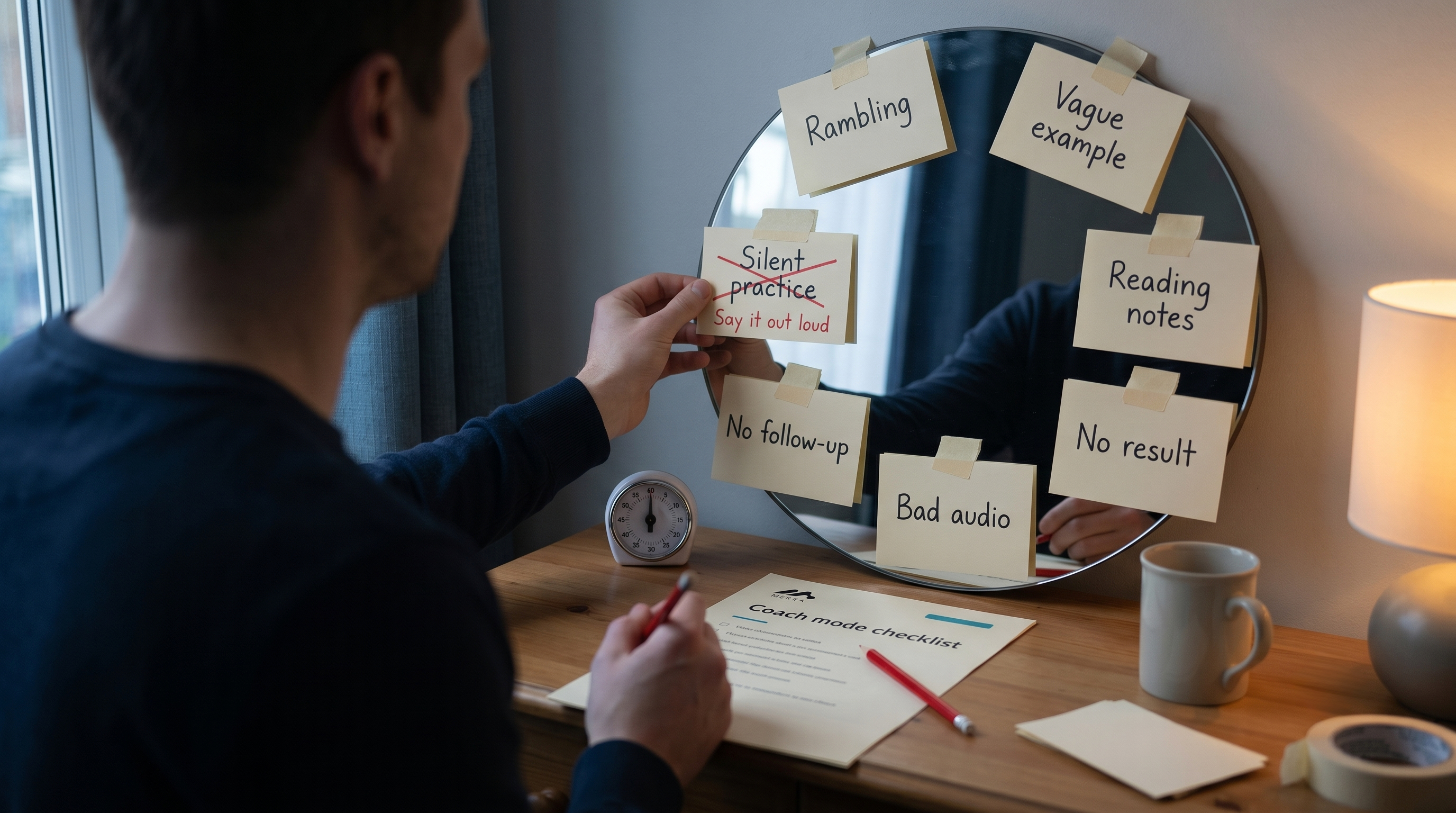
How to Pass an AI Interview: 7 Things Candidates Get Wrong
Learn how to pass an AI interview in 2026 - seven mistakes candidates make, from rambling and weak examples to reading notes, poor setup and never practising out loud before the real interview starts.
 Interview Tips
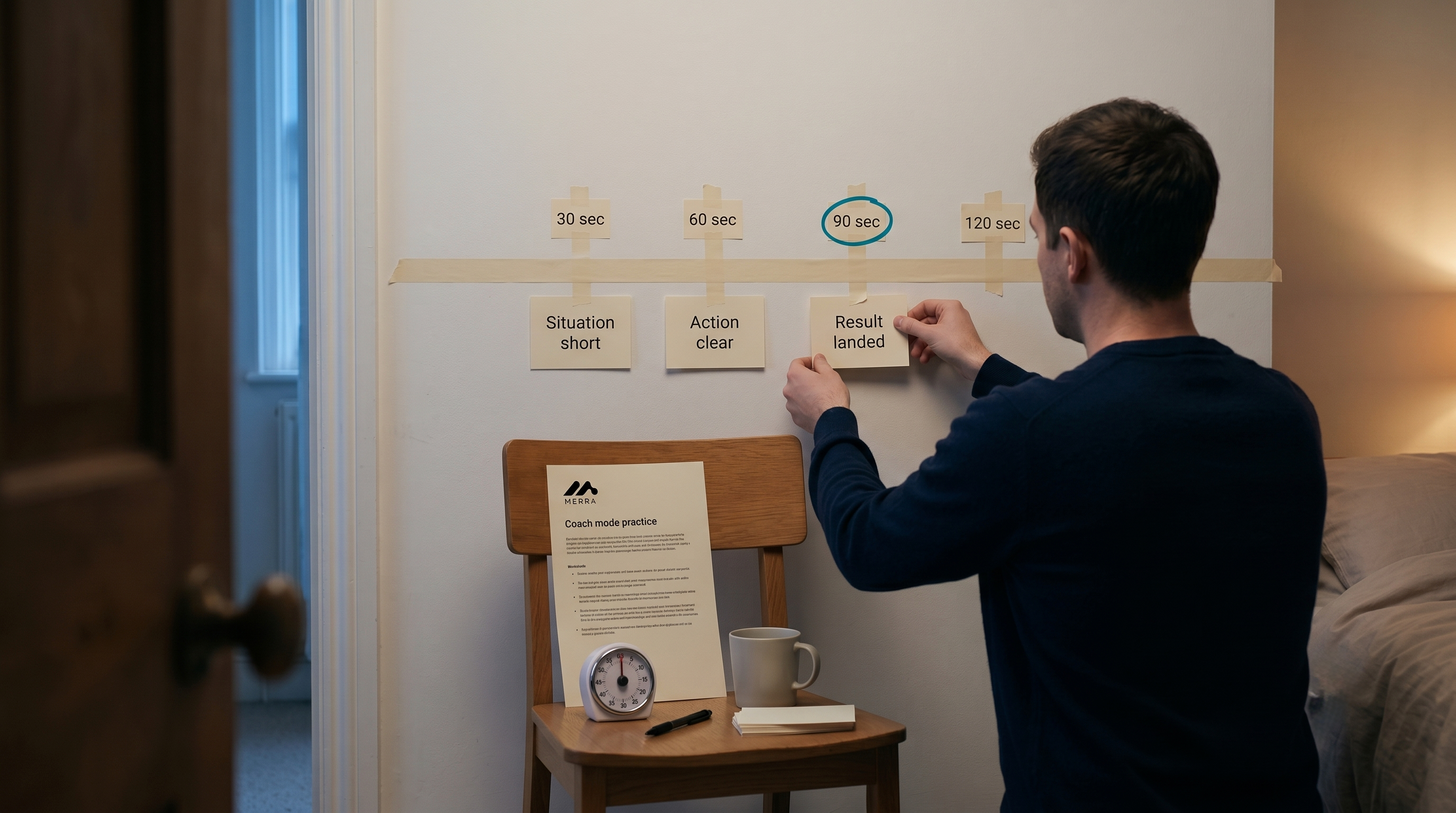
How Long Should AI Interview Answers Be? The 60 to 90 Second Rule
Learn how long AI interview answers should be in 2026: when to use 30, 60, 90 or 120 seconds, how to pace STAR answers, avoid rambling and practise timed replies before the real interview starts now.