10 interview questions that actually predict job performance
Most interview questions predict nothing. Here are the ten that actually do — with rubrics, signals, and follow-up probes for each.
The four questions that predict nothing
Before the ten that work, the four that don't. If your interview process leans on any of these, you are mostly hiring for the candidate's ability to flatter you under pressure.
"What's your biggest weakness?" — Invites rehearsed answers. Anyone who's interviewed twice has a humble-brag ready ("I work too hard", "I'm a perfectionist"). Predicts nothing about the job.
"Where do you see yourself in five years?" — Predicts a candidate's ability to construct a flattering narrative on demand. That isn't a job-performance signal.
"Why should we hire you?" — Tests pitch ability. Useful for sales hires when sales is literally the job. Useless for almost everything else.
"Tell me about yourself." — Fine as a warm-up. Worthless as an evaluation question. Most candidates have a polished 90-second answer that reveals nothing about how they work.
If you ran an interview process consisting only of those four questions, you would learn whether the candidate has done other interviews recently. Nothing else.
The ten below are different. They are designed to make rehearsed answers visibly fail.
What the research actually says
Two bodies of evidence sit underneath everything in this post.
The first is Schmidt and Hunter's 1998 meta-analysis of personnel selection methods, which summarised 85 years of hiring research. In that paper, structured interviews — same questions, same rubric, multiple evaluators — showed a validity coefficient of around 0.51 for predicting on-the-job performance, compared to roughly 0.38 for unstructured interviews. A more recent reanalysis by Sackett and colleagues (2022) revised most of these estimates downward by 0.10 to 0.20 points after correcting for range-restriction issues, but structured interviews still emerged as the top-ranked selection procedure overall. The exact number moves with the methodology; the ranking does not. The format is the single biggest variable in interview signal quality.
The second is Google's published work on structured interviewing, documented in Laszlo Bock's Work Rules! and on Google's re:Work site, which describes structured interviews as roughly 2× more predictive of on-the-job performance than unstructured ones, even when the same interviewer runs both. (This is separate from Google's Project Oxygen study, which looked at what makes managers effective — a related but different body of Google research.) Google now uses structured interviews across the company for exactly this reason.
The takeaway is simple. The questions you ask matter — but the structure around the questions matters more. Same questions, same rubric, same scoring framework, applied consistently to every candidate for the same role. Without that structure, even the ten questions below will give you noise.
With that structure, they will give you the most reliable interview signal you can produce as a human team without a research department.
How to use this list
For each of the ten questions below you'll see four things:
Testing for — the underlying capability the question is designed to surface.
Strong-candidate signals — specific behaviours to listen for, not adjectives.
Weak-candidate signals — the patterns that should give you pause.
Follow-up probe — the one question to ask if the first answer feels too smooth.
Use the same set across every candidate for the same role. Score each candidate on a 1–5 rubric per question. Have at least two interviewers score independently before discussing. That is what structured means in the research, and it is the gap between the structured and unstructured validity coefficients in the studies above.
The 10 questions
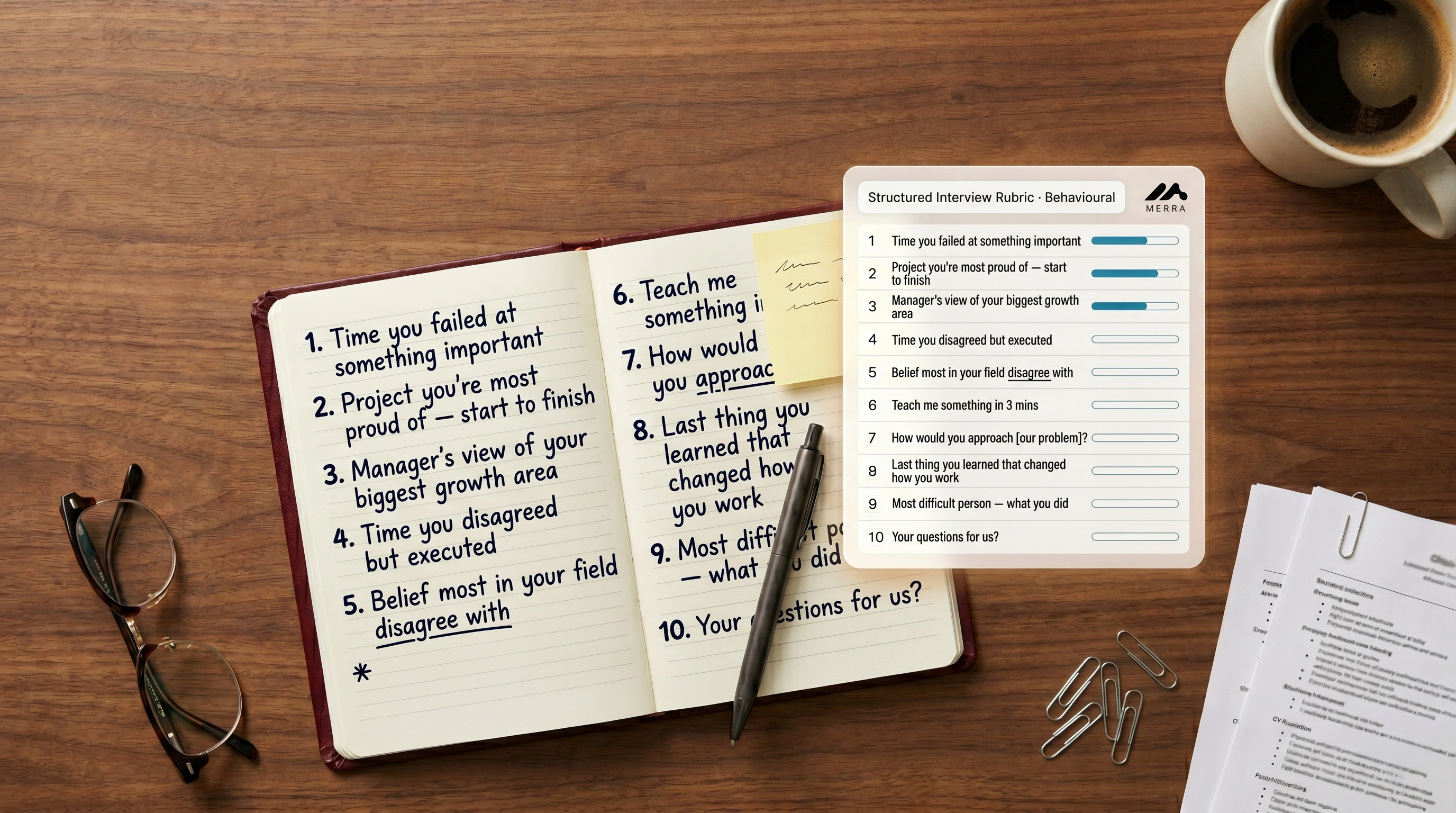
1. Tell me about a time you failed at something important
Testing for: self-awareness, accountability, the learning loop.
Strong signals: names a specific, non-trivial failure; owns their role in it without hedging; articulates what they'd do differently in concrete behavioural terms.
Weak signals: picks a humble-brag failure ("I cared too much"); blames teammates, manager, customer, market; can't articulate what actually changed afterward.
Follow-up probe: "When did you next have a chance to do that differently — and what happened?" This is the question that separates a story from a lesson.
2. Walk me through a project you're most proud of — from start to finish
Testing for: genuine ownership versus team-credit attribution; structured thinking under chronological pressure.
Strong signals: uses "I" and "we" with clear distinction; walks the project chronologically through decisions, not just outcomes; names the trade-offs they made and why.
Weak signals: uses "we" in every sentence without ever specifying what they personally did; skips straight to the success metric without process; vague on the line between their decisions and team decisions.
Follow-up probe: "What would have been the worst decision you could have made at [specific moment they mentioned] — and why didn't you make it?"
3. What would your last manager say is your biggest area for growth?
Testing for: honest self-knowledge under reference-check pressure. The candidate knows you could call.
Strong signals: names a real, specific weakness that isn't a strength in disguise; connects it to feedback they actually received; describes what they're doing about it.
Weak signals: disguised strengths ("I'm a perfectionist"); vague platitudes ("communication", "balance"); can't recall any actual feedback.
Follow-up probe: "If we called them today, what would they say has changed since you started working on it?"
4. Describe a time you disagreed with a decision but had to execute on it
Testing for: maturity, disagree-and-commit behaviour, professional disagreement under hierarchy.
Strong signals: articulates the original disagreement clearly; describes how they raised it (one-on-one, in writing, in a meeting); executes on the decision once made, without sabotage or passive resistance.
Weak signals: "I've never really disagreed with anyone" (a red flag at any level above intern); tells the story as a still-live grievance; executed but visibly half-heartedly.
Follow-up probe: "Were you right in the end? And what do you do differently when you turn out to be wrong?"
5. What's something you believe that most people in your field disagree with?
Testing for: critical thinking, conviction, original perspective on their craft.
Strong signals: holds an actual contrarian belief that's specific to their work; can articulate why they hold it and what evidence supports it; acknowledges what would change their mind.
Weak signals: generic popular contrarian framing in disguise ("I think AI will change everything"); can't think of one; holds a strong belief but can't defend it under one follow-up question.
Follow-up probe: "When did you last update that belief, even partially — and what caused it?"
6. Teach me something you know well in 3 minutes
Testing for: communication skill in motion, audience adaptation, depth versus surface expertise.
Strong signals: picks a topic with real depth (not a party trick); adjusts complexity for you mid-explanation; uses analogies grounded in your context, not their own.
Weak signals: reads off mental flashcards; goes too deep too fast or stays superficial throughout; never checks whether you're following.
Follow-up probe: "Now teach me the same thing again, but for a 12-year-old." This is where genuine expertise separates from memorised expertise.
7. Walk me through how you'd approach [a real problem we're facing right now]
Testing for: structured thinking, ability to handle ambiguity, judgement under unfamiliarity. Use a real problem from your team, not a hypothetical.
Strong signals: asks clarifying questions before jumping to solutions; frames the problem before solving it; names what they don't know and how they'd find out.
Weak signals: jumps to a generic answer they have prepared; solves the wrong problem confidently; doesn't acknowledge any unknowns.
Follow-up probe: "What's the assumption in your approach that you'd want to test first — and how would you test it cheaply?"
8. What was the last thing you learned that changed how you work?
Testing for: growth mindset, intellectual curiosity, recency. The recency matters as much as the content.
Strong signals: a specific learning from within the last six months; names a concrete change in behaviour as a result; comes from a non-obvious source (a book, a conversation, a mistake — not just LinkedIn).
Weak signals: generic answer ("communication is important"); the learning is two years old; learned it but can't name what changed.
Follow-up probe: "What's something you used to believe about [their craft] that you no longer do?"
9. Tell me about the most difficult person you've worked with — and what you did
Testing for: empathy, diplomacy, problem-solving under interpersonal stress.
Strong signals: describes the person with specificity but not contempt; owns their part in the dynamic; names what they tried, what worked, what didn't.
Weak signals: frames the other person as the villain throughout; "I just stayed out of their way" (avoidance, not management); hasn't reflected on what they could have done differently.
Follow-up probe: "What would they say working with you was like, in the same situation?"
10. What questions do you have about the team, the work, and the company?
Testing for: preparation, judgement about what matters, intellectual hunger about the actual job.
Strong signals: specific, researched questions about the role and team; at least one question about how decisions are made or how disagreement works; questions about the work, not just the perks.
Weak signals: "I have no questions" / "you've covered everything"; only asks about salary, hours, or remote policy; questions answered on the careers page.
Follow-up probe: "Of everything we've discussed today, what's the one thing you'd want to dig deeper on if we had another hour?"
One thing the questions can't do alone
The ten questions above are the right content. They're not the right system.
A structured interview only earns its 2× lift over an unstructured one when three things are true:
Every candidate for the same role gets the same questions in the same order.
Every candidate is scored against the same rubric by the same scoring scale.
At least two interviewers score independently before they discuss.
The research is clear that doing one of those three gets you a small lift. Doing all three is the difference between an interview process that compounds your hiring quality over time and one that produces noise dressed up as signal.
This is the work most interview processes quietly skip. It's also the work AI interviewing platforms can do at the volume of your actual inbound funnel — same questions, same rubric, recording and transcript and structured evaluation on every applicant, scored consistently and auditable six months later. We've written more about why this matters in our buyer's guide to AI screening software, and about why the older formats (CVs, one-way videos) can't produce this kind of evidence in our founder post on why we killed the one-way video interview.
The ten questions and the structure around them are the same idea: replace gut feel with evidence.
From questions to evidence
Asking the right ten questions is half the work. Capturing what the candidate actually said, scoring it consistently, and being able to defend the decision six months later is the other half.
Merra runs this exact framework on every applicant for the roles you set it on. Same questions, same rubric, recording, transcript, structured evaluation, decision summary. You get the evidence pack; the AI runs the structure.
Run a pilot on one role and see the evidence pack Merra gives your team.
FAQ
What's the single most predictive interview question?
No single question carries the load. The research is consistent on this: the predictive power comes from the structure (same questions, same rubric, multiple evaluators), not from any individual question. That said, if forced to pick the highest-signal single question from the ten above, it would be #7 — walking through a real problem you're facing. It tests the largest set of underlying capabilities (structured thinking, ambiguity tolerance, judgement, communication) in a single answer, and it's the hardest to rehearse.
How long should a structured interview be?
For a first round, 30–45 minutes covering 5–7 of the ten questions is the right shape. Longer than 60 minutes erodes candidate experience without adding signal. Shorter than 25 minutes doesn't give the follow-up probes room to do their work — and the follow-ups are where rehearsed answers fall apart.
Do behavioural interview questions work for technical roles?
Yes, but they aren't a substitute for skills assessments. The right shape for technical roles is: behavioural questions like the ten above for first-round screening (covering communication, problem framing, team dynamics, learning), then a paid take-home or live exercise for skills evaluation. The behavioural questions tell you whether you want to work with this person; the skills exercise tells you whether they can do the work. You need both.
How do I score behavioural questions consistently?
Use a 1–5 rubric per question. Define what a 1, 3, and 5 actually look like before you start interviewing. Score independently from any co-interviewer. Discuss only after both scores are written down. The single most common mistake in scoring is letting the first interviewer's score anchor the second — this collapses two independent signals into one noisy one.
Should I use the same questions for every candidate?
For the same role, yes — that's the whole point of structured interviewing. For different roles, build a different set tailored to the focus areas of that role. The ten above are a strong default starting set; you'll want to swap 2–3 of them out depending on whether you're hiring for an individual contributor, a manager, or a senior leadership role.
Ahmed Ghelle is the founder of Merra, an AI interviewing platform that runs structured first-round interviews on every applicant and produces a recording, transcript, and scored evaluation for each one. He writes about hiring, evidence, and the difference between speed and signal.
Ready to ace your next interview?
Practise realistic mock interviews with conversational AI and get actionable feedback. Start with a free interview.
Start your free interviewsKeep reading
 Interview Tips
Interview Tips for 2026: How to Prepare, Answer Well and Make a Strong Impression
Practical interview tips for 2026: how to prepare stories, answer clearly, handle nerves, read the room, ask better questions and follow up after in-person, video or panel interviews with confidence.
 Interview Tips
How to Pass an AI Interview: 7 Things Candidates Get Wrong
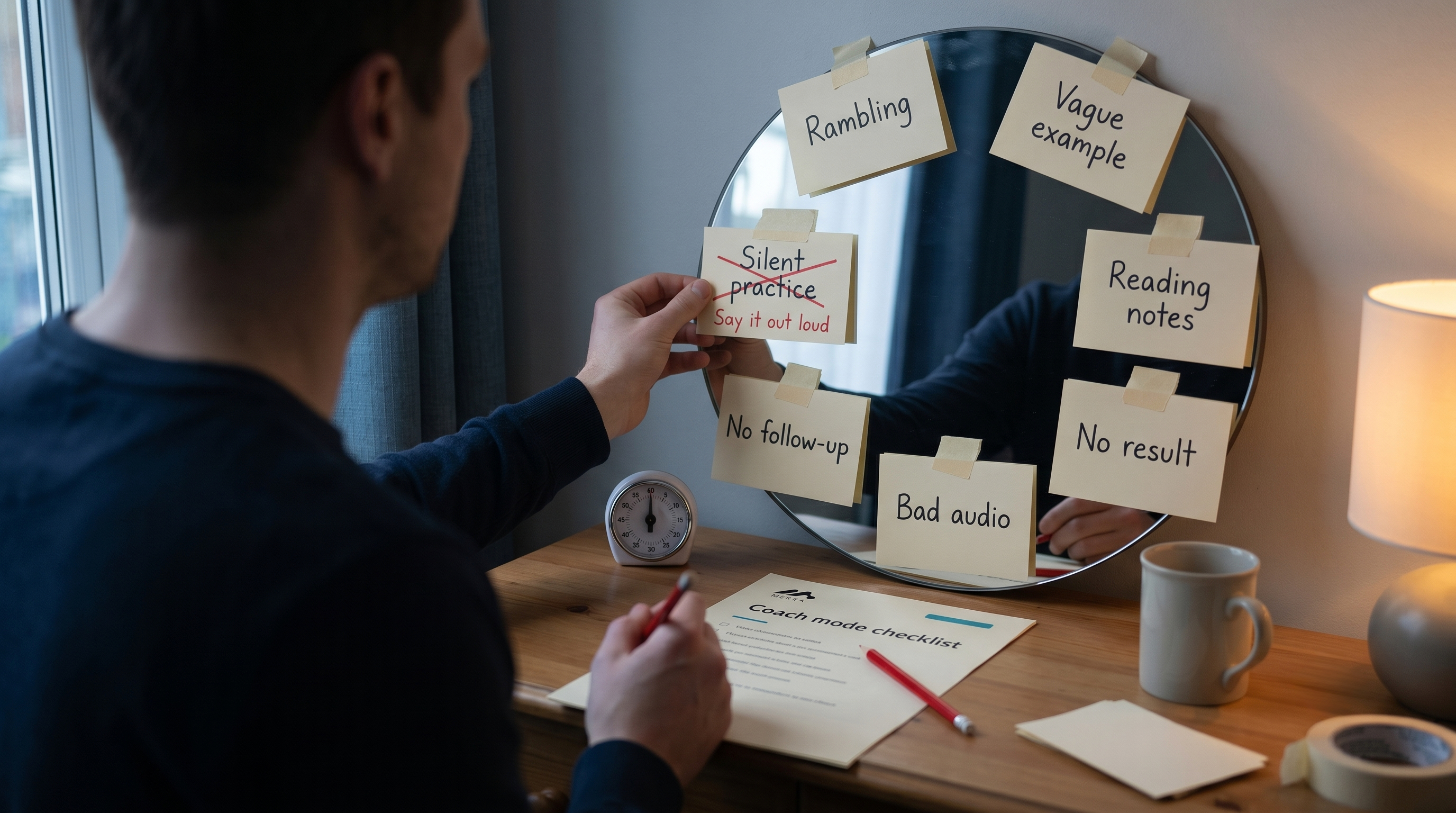
Learn how to pass an AI interview in 2026 - seven mistakes candidates make, from rambling and weak examples to reading notes, poor setup and never practising out loud before the real interview starts.
 Interview Tips
How Long Should AI Interview Answers Be? The 60 to 90 Second Rule
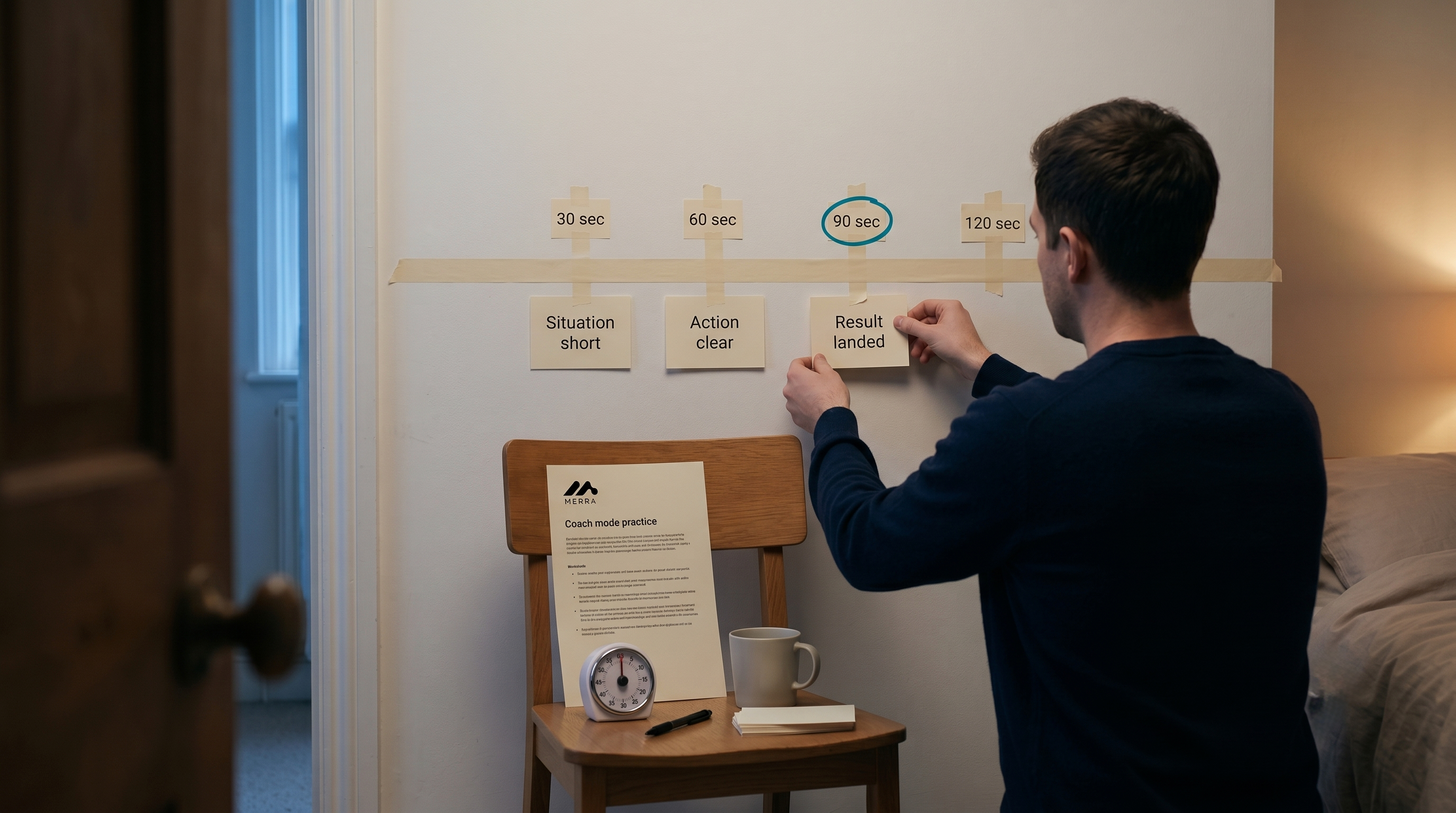
Learn how long AI interview answers should be in 2026: when to use 30, 60, 90 or 120 seconds, how to pace STAR answers, avoid rambling and practise timed replies before the real interview starts now.